


Stories of torture victims in southern Russia highlight the importance of protecting their rights.
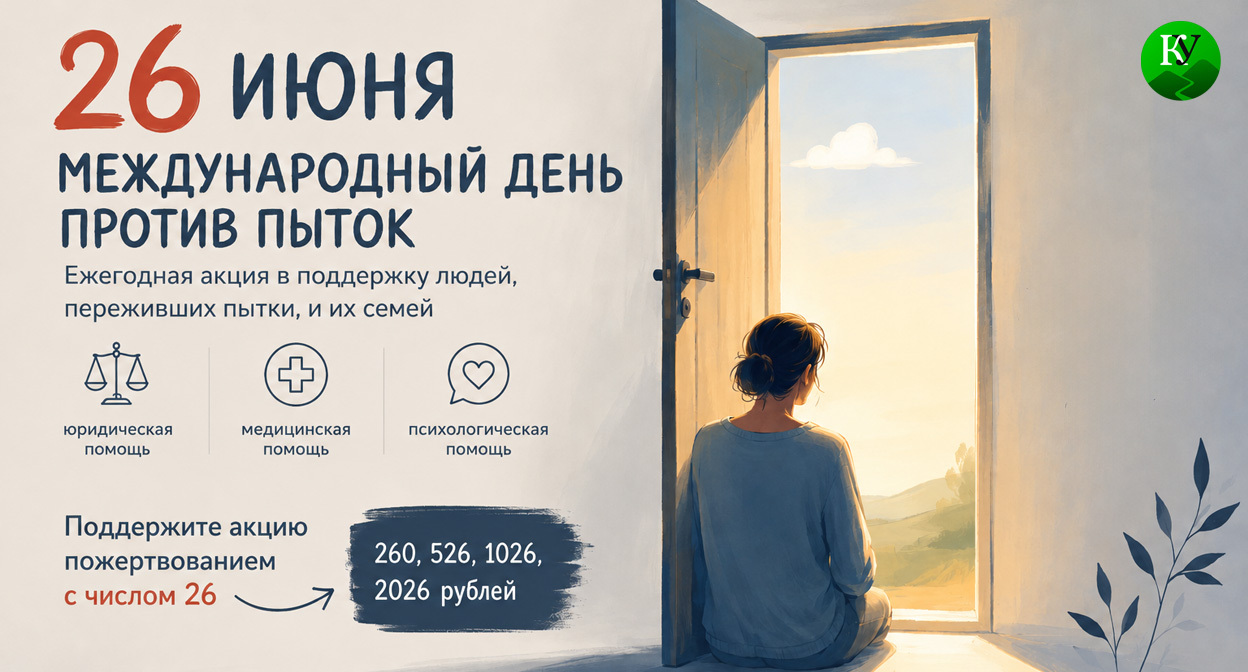
Torture victims and their families face the consequences of violence for years, and court proceedings are also protracted, according to stories from victims in Kuban, Rostov Oblast, Dagestan, and other regions of southern Russia. A fundraising campaign for legal and psychological support for victims has been launched to coincide with International Day in Support of Victims of Torture.
Torture has become a common practice in Russia, and achieving both recognition of torture and bringing perpetrators to justice often requires years of struggle. On International Day in Support of Victims of Torture, celebrated on June 26, the Committee Against Torture Foundation launched its annual campaign, "26 Rubles Against Torture." To participate, simply make a donation of any amount starting with 26—for example, 260, 526, 1026, or 2026 rubles. The campaign will run until June 26th.
The campaign's goal is to raise 2.6 million rubles for three months of direct assistance to victims. This money will cover the work of doctors and psychologists who help them recover their health and return to normal life; independent experts and lawyers who collect evidence of torture and seek punishment for those responsible; and defense attorneys.
"Compared to the scale of the problem, convictions for torture today are still few. But it is difficult to imagine what the situation would be like if this work were not carried out at all."
In Russia, there are no official statistics reflecting the true scale of the torture problem, yet in 81% of cases, criminal cases against torture complaints are immediately dismissed. Torture survivors require years of support from lawyers, doctors, and psychologists to restore their health and psyche, and to seek justice. The state does not provide such assistance. The foundation, which relies on private donations, provides free assistance to victims of torture. Over the past seven years, 600 victims have received assistance, 11 convictions have been handed down in torture cases, and victims have also received over 7.5 million rubles in compensation.
In previous years, the "26 Rubles Against Torture" campaign has raised over 1.5 million rubles and attracted nearly 4,500 donors.
"Torture cases last for years: on average, about three years, and sometimes five, seven, or even longer. The health and psychological consequences can linger even longer. We support each case legally until we exhaust all legal avenues to obtain state recognition of torture, punishment of the perpetrators, and compensation. Yes, compared to the scale of the problem, convictions for torture remain few today. But it's hard to imagine what the situation would be like if this work were not carried out at all," noted Stepan Chigantsev, Director of the Committee Against Torture Foundation.
Policeman Sentenced to Sentence for Death of Krasnodar Resident After Beating at Police Station
One of the stories of assistance, when we were able to bring those responsible for torture to justice, is the story of Krasnodar resident Ilya Afrosin.

On March 3, the court sentenced police officer Dmitry Korchagin, who was charged in the death of Ilya Afrosin. to six years in a maximum-security penal colony. The prosecutor's office challenged the lenient sentence; the state prosecutor had demanded 11 years in prison. Afrosin's family plans to seek compensation for moral damages for his death.
The five-year trial was filled with intense stress, anxiety, and disappointment. Ilya's father suffered a heart attack due to stress, but thanks to the foundation and the qualified legal assistance—competent and timely—the process was completed and a verdict was handed down.
The foundation has been supporting the family for five years and continues to do so.
"Over the five years of the trial, there was a great deal of stress, anxiety, and disappointment. Ilya's father suffered a heart attack due to stress, but thanks to the foundation and the qualified legal assistance—competent and timely—the process was completed and a verdict was handed down. A huge thank you to the foundation and the people who support it," said Svetlana Kotsareva, sister of Ilya Afrosin, who died after being tortured.
"Caucasian Knot" has reported on other cases of deaths in security forces detention in southern Russia. In several cases, police officers have been accused of involvement in the deaths. On July 9, 2024, Akhmed Dzhabrailov, a member of the Akhmat special forces unit, died in the Sovietsky District Police Department of Makhachkala after being detained for disturbing the peace. According to investigators, Dzhabrailov was beaten and tasered. In January 2023, Kurban Dalgatov, a Makhachkala resident, died after being detained in the same police station. The man sustained injuries before his death, the Ministry of Internal Affairs admitted.
In some cases, the fight for justice is just beginning.

Two months later, investigators also opened a criminal case following the death of Alexei Shatov, a detainee, at a police station in the Rostov region. His relatives were informed of his death with the words, "It just happened."
According to the forensic medical examination, the cause of death was acute combined poisoning. According to them, the man also suffered serious injuries to his body – a fractured skull, intracranial hemorrhages, blunt trauma to the lumbar region, a subcapsular rupture of the right lobe of the liver, and numerous abrasions and bruises, human rights activists reported.
The fight for justice also ended with a verdict in the case of the beating of Fyodor Valko
Fyodor Valko, a watchman from the Prikubansky farm, was detained by police in August 2023 on suspicion of theft from a factory. While extracting a confession, security officers beat him, including with a chair, until he lost consciousness. Doctors diagnosed him with three fractured vertebrae, abrasions, bruises, and a hemorrhage in the eye. In December 2023, Valko said that four months later, the after-effects of the beating were interfering with his ability to work.
They generally consider themselves innocent.
Valko said that the police officers who beat him made no attempt to reconcile or atone for their guilt. "They generally consider themselves innocent," he emphasized.
In May 2025, the court found police officers Yevgeny Samonov and Ivan Tatsenko guilty of beating Fyodor Valko. One of them received a four-year prison sentence, the other three years. On February 4, it became known that they were sent to a penal colony in the Kirov region, but already in June, a court in the Kirov region sentenced Yevgeny Samonov to correctional labor in the penal colony.
The victim of the actions of security forces required surgery and the help of a psychologist.
Torture in penal colonies and prison hospitals—only a small part of what's happening is known It's worth noting that reports of torture in penal colonies and prison hospitals periodically emerge. Due to the closed nature of these institutions, information is also only partial. For example, the human rights project Gulagu.net* published video evidence of violence in Russian penal colonies. These materials demonstrate that long-standing complaints of torture in penal institutions are not an exaggeration by lawyers and human rights activists. The "Caucasian Knot" report collected information about several high-profile cases of violence and torture against people from the Caucasus in Russian prison colonies. In January 2024, a court sentenced the former deputy head of the Federal Penitentiary Service's tuberculosis hospital, Alexander Lyakh, to seven and a half years in prison, finding him guilty of organizing the torture of patients. Head of the psychiatric department, Daria Pozdnyakova, received six years, and psychiatrist Anastasia Potorochina received five years. The convicts demanded that the sentences be overturned, insisting on their innocence, but the regional court upheld the sentences. In February 2025, Alexander Lyakh signed a military contract and left the penal colony. Following this, another case of torture in the Rostov prison hospital was opened, but investigators failed to identify suspects and closed the investigation. Oleg Sokurenko, a lawyer for several victims in the Rostov prison hospital torture case, appealed the termination of the investigation. Meanwhile, the torture victims themselves no longer believe that the perpetrators will be punished. Sixty-two victims testified against hospital doctors, according to the Caucasian Knot report "The Case of Torture of Prisoners in a Rostov Hospital". We have updated the apps for Android and IOS! We would be grateful for criticism and ideas for development both in Google Play/App Store and on KU pages in social networks. Without installing a VPN, you can read us on Telegram (in Dagestan, Chechnya and Ingushetia - with VPN). Using a VPN, you can continue reading "Caucasian Knot" on the website as usual, and on social networks: Facebook**, Instagram**, "VKontakte", "Odnoklassniki" and X. You can watch the "Caucasian Knot" video on YouTube. * are listed as foreign agents. ** Meta (owner of Facebook, Instagram, and WhatsApp) is banned in Russia.
Translated automatically via OpenAI from https://www.kavkaz-uzel.eu/articles/424385


![Tumso Abdurakhmanov. Screenshot from video posted by Abu-Saddam Shishani [LIVE] http://www.youtube.com/watch?v=mIR3s7AB0Uw](/system/uploads/article_image/image/0001/18460/main_image_Tumso.jpg "Tumso Abdurakhmanov. Screenshot from video posted by Abu-Saddam Shishani [LIVE] http://www.youtube.com/watch?v=mIR3s7AB0Uw")