

A Krasnodar resident called on the Patriarch to prevent development on the embankment.
A solo picket calling on Patriarch Kirill of Moscow and All Rus' to prevent the construction of a church on Rozhdestvenskaya Embankment took place in Krasnodar.
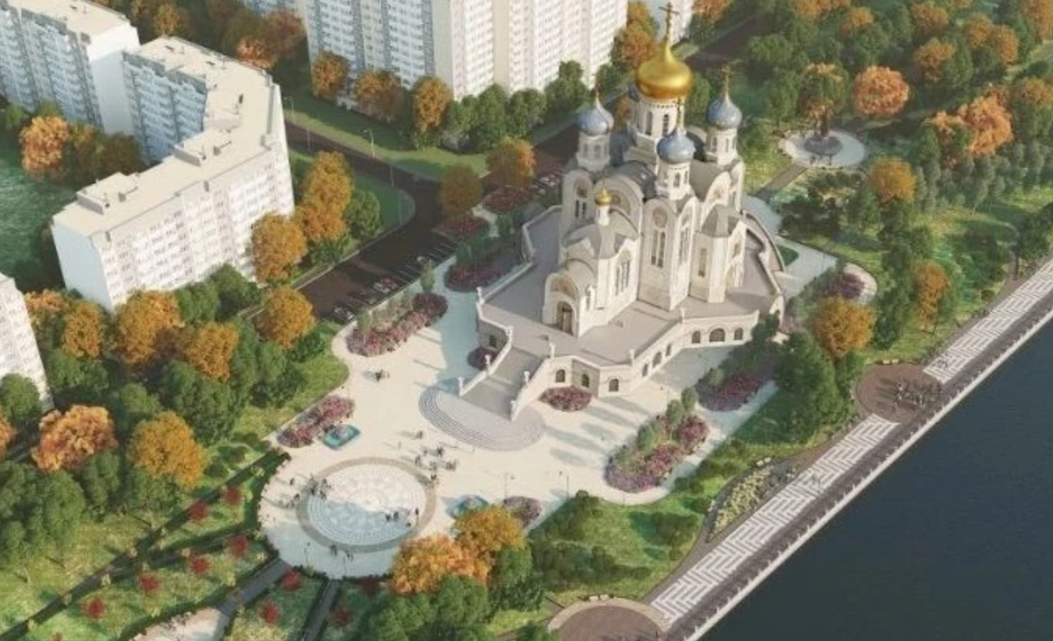
As reported by the "Caucasian Knot," on January 16, despite protests from residents, the mayor of Krasnodar approved the Rozhdestvenskaya Embankment plan in the Yubileiny microdistrict, where a church is planned to be built. On January 29, Krasnodar City Duma deputies approved a decision to seize part of the park for the construction of a church. On January 26 and 29, pickets were held in defense of the embankment and demanding the resignation of the mayor, Yevgeny Naumov. On March 19, 99% of participants in the public discussion voted against holding religious ceremonies on the Rozhdestvenskaya Embankment in Krasnodar. However, the commission deemed the opinions of those opposed to the church construction irrelevant and recommended that the mayor grant permission for religious services on the embankment. The results of the public discussion of the project to build a church on Rozhdestvenskaya Embankment in Krasnodar are advisory in nature; the commission, consisting of government representatives, simply ignored the opinions of residents.
Previously, the public discussion of the church construction plans lasted a week, but not everyone was able to participate. Residents distributed leaflets and held pickets, but the opinions of those opposed to the construction were ignored. Activists submitted a request to the administration for a rally against the development of a green space, but they were only allowed to protest in Klenovy Park, which is located 10 kilometers from the microdistrict.
A solo picket against the development of a temple complex on the Yubileiny River embankment was held in the Yubileiny microdistrict of Krasnodar. The poster read: "Patriarch, stop the construction of the YMR alley!", RusNews reports.
The activist held a picket at the Nativity Church, which is located a five-minute walk from the site where a new church is planned to be built on the Rozhdestvenskaya Embankment, writes activist Yana Antonova.
"During public discussions, residents of Yubileyny twice, an absolute majority of those who took part, spoke out against the construction of a church in their favorite recreation area. But the Krasnodar administration stubbornly intends to hand over the embankment for construction," she noted.
YMR activists are preparing to personally appeal to the head of the Russian Orthodox Church during his visit to the city, 93.ru reports.
Official confirmation of the event appeared on the KubSU website.
Patriarch Kirill of Moscow and All Russia will visit Krasnodar on April 25, but not for A conversation with activists—the topic is still unknown. The meeting will be held at the university campus at 149 Stavropolskaya Street, from 8:00 AM to 5:00 PM.
As a reminder, on December 15, 2025, residents of Krasnodar's Yubileyny microdistrict, protesting against embankment development, recorded a video message to Vladimir Putin, but their question was not voiced during the president's direct line.
Activists comment on the results of the discussion on the construction of a church on the embankment in Krasnodar
THIS MATERIAL (INFORMATION) WAS PRODUCED AND DISTRIBUTED BY THE FOREIGN AGENT OOO "MEMO", OR CONCERNING THE ACTIVITIES OF THE FOREIGN AGENT OOO "MEMO".
The results of the public discussion of the project to build a church on Rozhdestvenskaya Embankment in Krasnodar are advisory in nature. The commission, consisting of government representatives, simply ignored the opinions of the residents.
As "Caucasian Knot" reported, on January 16, the head of Krasnodar, despite protests from residents, approved the planning project for the Rozhdestvenskaya Embankment in the Yubileiny microdistrict, where a church is planned to be built. On January 29, deputies of the Krasnodar City Duma approved the decision to seize part of the park for the construction of a church. A month earlier, on December 15, 2025, residents of the Yubileiny microdistrict of Krasnodar, protesting against the development of the embankment, recorded a video message to Vladimir Putin, but their question was not voiced during the president's direct line. On January 26 and 29, pickets were held in defense of the embankment, as well as demanding the resignation of the mayor, Yevgeny Naumov. On March 9, 99% of participants in the public discussion spoke out against the conduct of religious ceremonies on the Rozhdestvenskaya Embankment in Krasnodar. However, the commission considered the opinion of those opposed to the construction of the church irrelevant and recommended that the mayor grant permission for religious services to be held on the embankment.
Earlier, the public discussion of the plans for the construction of the church lasted a week, but not everyone who wanted to participate was able to participate. City residents distributed leaflets and held pickets, but the opinions of those opposed to the construction were not taken into account. Activists submitted an application to the administration for a rally against the development of the green space, but they were only allowed to rally in Klenovy Park, which is located 10 kilometers from the microdistrict.
Public discussions are effectively equivalent to public "There are hearings, but they are being held virtually," former Krasnodar deputy and activist Vitaly Cherkasov told a "Caucasian Knot" correspondent, commenting on the March 12 public discussions on permitting religious ceremonies on two sites on the embankment in Krasnodar's Yubileyny microdistrict.
"Public hearings, allowing for a microphone to be used in the hall, are currently only being held on budgetary matters. At least in Krasnodar. Everything else is called public discussion here. It's a kind of mockery—public hearings in absentia. We send comments and objections through "golos krd dot ru." That is, people don't gather together, don't see each other, don't see each other's reactions, and don't feel supported. To participate, they register through Gosuslugi. Supposedly, there should also be an option to send information via email; a passport scan is also required. The discussion took place on two sites with different cadastral numbers, which were proposed for the construction of a church. "Azbuka Gorozhanina" (ABCs of a Citizen) contains links to PDF files with the names of those discussing the matter. One lists 853 people, the other 799," he said.
In his Telegram channel, "Azbuka Gorozhanina," Cherkasov published the results of the public discussions, according to which 843 people voted "no" in one section (10 voted "yes"), and 791 people voted "no" in the other (eight voted "yes").
According to the activist, the authorities illegally divided the discussion of the land they want to transfer to a church into two sections and two separate discussions. "The whole 'thing' is that the hearings themselves are illegal, because they divided the public discussion into two sections. That is, the area is 7,200 square meters. They decided to transfer it for religious ceremonies. But 7,200 meters cannot be transferred by law. A maximum of 5,000 meters is allowed. And to get around this, they came up with this childish way of dividing it into two sections. This is an absolute violation. The administration officially organized these public discussions. But not a single newspaper wrote about it, no television coverage, and no posters were displayed," Cherkasov said. According to him, the administration, in order to discredit the results of the discussions, claimed that the participants were not residents of the districts. The funniest and most tragic thing is that, ultimately, the land use commission, which consists of officials and members of parliament, told many residents that they were not real participants. "Because they allegedly don't own the land next door, don't live there, and so on. And where are we supposed to live? We should live right on the embankment. I don't know who lives on the embankment except the homeless. Or maybe seagulls live there, and in the summer, ants. In fact, some of the residents who participated in the discussion live in nearby ten-story buildings, which are 30 meters high, and the church is planned to be 65 meters high. That means it will be twice as tall. Plus, how many people will come and park somewhere? This construction will take many years. In short, it's clear that this affects all residents of Yubileyny, and their rights could be violated," Cherkasov believes.
Ultimately, in this case, the commission recommended transferring the plots for religious purposes. And the final decision, in any case, rests with the head of the administration.
He noted that, according to the Urban Development Code, public discussions are required, but their results are advisory in nature. "This could influence the decision of the commission, which is ostensibly independent, although in reality it is composed entirely of pro-government people. But ultimately, in this case, the commission recommended transferring the land to religious use. And the final say in any case rests with the head of the administration," Cherkasov explained.
He also noted that supporters of the construction are trying to find "anti-Christian" motives in opposing the destruction of the green zone. "All sorts of pro-government political scientists are reducing the situation to absurdity, saying that everyone who is against it is not for the green zone, but is against Christianity," Cherkasov concluded.
Another activist from Yubileyny, who wished to remain anonymous, said that the problem is that deputies, not to mention officials, do not consider themselves obligated to act in the interests of residents.
"Our elections are being conducted disgracefully. Essentially, there is only one opposition deputy left for the entire city council. It's not particularly interesting what they say about the people... They don't care about the real opinions of citizens; they simply don't care. It's the same with the administration. The mayor is appointed, not elected anymore. Consequently, he's not interested in anything about the citizens; he's said so openly himself. That's why there were 40 refusals at the Yubileiny rally," he said.
"I believe that until our country has normal, fair elections where deputies from the people and for the people win, this kind of thing will continue. Right now, decisions are being made that are guided not by public opinion, but by the opinions of their superiors, by the law of the land. "This is the root of the problem," the activist concluded.
To defend their position, city residents should go to court
One of the founders of the non-profit organization "Green Stanitsa" from the village of Poltavskaya, Sergey Salnikov, told a "Caucasian Knot" correspondent that, according to Article 14 of the Constitution, no religion can be established as a state or mandatory religion.
"In our country, people are religious or non-religious, and no religion should be imposed on people. In this case, I see their constitutional right to express their opinion. People have every right to express their opinion. "We also took advantage of this moment when we defended our rights against the landfill in Poltavska," he said.
Residents of Poltavska waged a long battle to close the landfill. On December 4, 2023, the landfill was closed. Opponents of the landfill have repeatedly faced administrative and criminal prosecution. They consider this pressure and retaliation for their active position regarding the landfill. On December 14, 2023, authorities announced that the landfill would be excluded from the territorial scheme for the management of municipal solid waste, according to the "Caucasian Knot" report "The Struggle of Poltavska Residents Against the Landfill".
According to the activist, any gathering of residents will be perceived as pressure on a sore spot, especially if they are repeated. Then the authorities will be forced to respond to this, actively filing complaints and lawsuits. "If protest sentiment is truly widespread, they should, at a minimum, urgently do what we did – create a non-profit environmental organization that can be legally represented in court. Because it's better for legal entities, not individuals, to sue the administration or the Russian Orthodox Church, which is affiliated with the state," Salnikov noted.
According to him, the actions of Russian officials are not truly for the people, and only unity can force them to work in their interests. "Often, officials represent and protect each other's interests. Even at the local government level, our leaders dislike public gatherings. Therefore, they can cite the danger of holding mass events and ban them. And if people want to defend their rights, they will have to resort to legal action, where their rights will be truly represented. This includes holding permitted assemblies, which they will naturally be prevented from doing. We worked right up until the highway was closed. People were issued fines for participating, and our NGO helped them pay them, advising them to limit their participation to two events. Only then did they come forward to talk to us. Because the problem has already reached a higher level than the municipality of our small district," Salnikov explained.
However, the law does not establish a direct obligation to take into account the majority of opinions. The consideration of results is advisory in nature.
Lawyer Timofey Shirokov confirmed to a "Caucasian Knot" correspondent that public discussions are advisory in nature. "According to parts 21–23 of Article 5.1 of the Civil Code of the Russian Federation, following the public discussions, the organizer is obliged to prepare a conclusion on the results, which must indicate: the number of participants; the essence of the proposals and comments made; reasoned recommendations on the advisability or inadvisability of taking each of them into account; and general conclusions. Thus, the formal responsibility of the authorities is to conduct the procedure, record opinions, analyze them, and publicly justify the decision made. However, the law does not establish a direct obligation to take into account the majority of opinions. The consideration of results is advisory in nature. "character," he said.
Lawyer Felix Vertegel, in turn, noted that any public mass event (rally, march, etc.) must be pre-approved (permitted) by the administration. "As for the construction, it can be challenged in court, but to do this, we need to understand how and by whom the decision to build was made," he told a "Caucasian Knot" correspondent.
"Caucasian Knot" also wrote that in November, opponents of the construction of the church in Yubileiny, together with representatives of the Communist Party of the Russian Federation, began collecting signatures demanding the resignation of Mayor Yevgeny Naumov.
In September 2024, residents of the Yubileiny microdistrict of Krasnodar protested against the construction Rozhdestvenskaya Embankment, where, according to the city's new general plan, a church was planned. They explained that this was the only major recreation area in the neighborhood. Activists collected signatures for a petition to Governor Veniamin Kondratyev against the development of Rozhdestvenskaya Embankment. More than 3,000 signatures were collected. Activist Vitaly Cherkasov and City Duma deputy Alexander Safronov were detained while collecting signatures and fined by the court. However, in November, city council deputies adopted a new general plan despite protests from residents.
Residents of the neighborhood actively protested against the development of the embankment, explaining that it was the only major recreation area in the neighborhood. However, in November 2024, city council deputies adopted a new general plan despite their protests.
Back in December 2021, activists protested against the construction of a new church on the embankment in Krasnodar, and residents of the Yubileiny neighborhood also protested. Embankment defenders believe it is necessary to build educational and leisure facilities for children in the neighborhood. In January 2022, activist Yana Antonova held a solo picket against the transfer of land on the embankment to the Russian Orthodox Church for the construction of a church.
We've updated our apps for Android and IOS! We welcome criticism and development ideas both on Google Play/App Store and on KU's social media pages. You can follow us on Telegram without a VPN (with a VPN in Dagestan, Chechnya, and Ingushetia). Using a VPN, you can continue reading "Caucasian Knot" on the website as usual, and on social networks: Facebook*, Instagram*, "VKontakte", "Odnoklassniki" and X. You can watch the "Caucasian Knot" video on YouTube. Send messages to +49 157 72317856 on WhatsApp*, to the same number on Telegram, or write to @Caucasian_Knot.
* Meta (owner of Facebook, Instagram, and WhatsApp) is banned in Russia.
Translated automatically via OpenAI from https://www.kavkaz-uzel.eu/articles/422089

![Tumso Abdurakhmanov. Screenshot from video posted by Abu-Saddam Shishani [LIVE] http://www.youtube.com/watch?v=mIR3s7AB0Uw](/system/uploads/article_image/image/0001/18460/main_image_Tumso.jpg "Tumso Abdurakhmanov. Screenshot from video posted by Abu-Saddam Shishani [LIVE] http://www.youtube.com/watch?v=mIR3s7AB0Uw")