

The injury of a woman in Karabulak demonstrated the authorities' inability to eradicate gunfire at weddings.
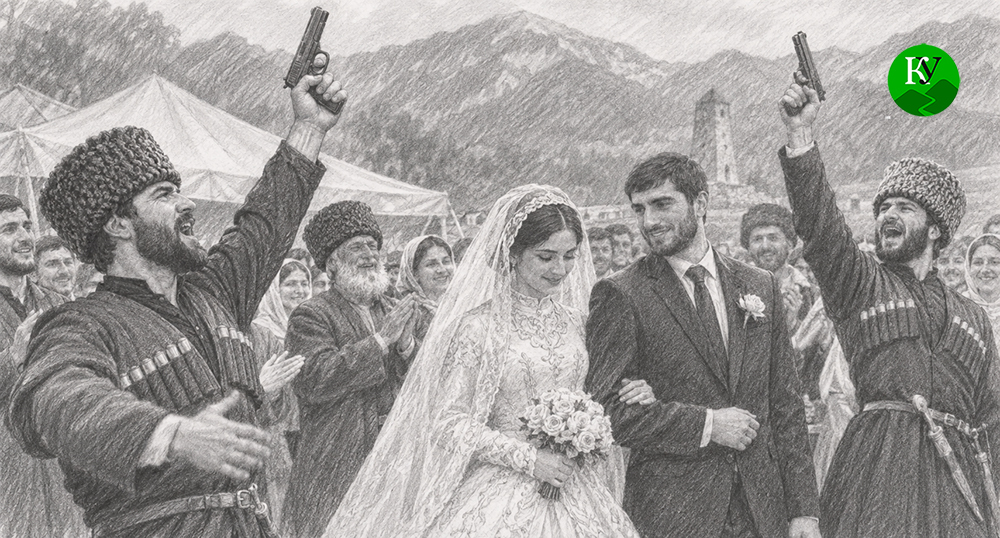
The fight against gunfire at weddings in the republics of the North Caucasus is conducted by the authorities through Article 20.13 of the Administrative Offenses Code of the Russian Federation, which provides for fines of up to 100,000 rubles, while Ingush imams and elders have imposed a direct ban on it. However, this tradition continues to pose a danger, as evidenced by the injury of a resident of Karabulak from a firearm by a participant in a wedding convoy.
As reported by "Caucasian Knot", on November 14, it became known about the improvement of the condition of a resident of Karabulak who was shot in the head on November 7. According to the Ministry of Internal Affairs, the woman became an accidental victim of gunfire from a participant in the wedding convoy.
In September 2020, the elders and imams of the Nazran district decided to ban gunfire at weddings. Violators were threatened with a fine of 50,000 rubles for the benefit of the needy. This measure was of a public nature, rather than an administrative one provided for by republican law, reported the newspaper "Ingushetia" on September 25, 2020, citing the press service of the Nazran district administration.
Gunfire into the air at weddings in Ingushetia has a long-standing tradition and continues to persist despite the danger to those around. Initially, shots were used to alert villagers to the approaching wedding procession, noted Ingush human rights activist Magomed Mutsolgov.
"This is the same tradition as firing a cannon in St. Petersburg and Murmansk, salutes at the funerals of military leaders <…>. Shots were fired when the wedding procession approached the groom's or bride's house to signal to the villagers that it was time to gather, as they could not wait all day, having been pulled away from their chores," Mutsolgov told a correspondent of "Caucasian Knot".
He emphasized that the danger is primarily associated with the use of weapons loaded with live ammunition.
"Unfortunately, there are irresponsible people who shoot not with blank cartridges, but with rubber bullets or live ammunition, which leads to tragedy. Moreover, most shooters are representatives of law enforcement agencies, as only they can carry weapons under strict conditions with checkpoints. And they often do not pay attention to what kind of ammunition is loaded in the weapon. Because of this, gunfire at weddings, unfortunately, ends in tragedy every few years. Therefore, this incident with the injury of a woman in Karabulak is not the first and, unfortunately, apparently not the last," Mutsolgov stated.
The custom of shooting at weddings persists in Ingushetia, although in recent years there have been restrictions and fines for such actions, noted one of the ethnographers.
"In fact, this phenomenon has always existed. But, as far as I know, in recent years such shooting has been banned and heavy fines are imposed on offenders," he told a correspondent of "Caucasian Knot" on condition of anonymity.
According to the opinions of the Caucasian studies experts interviewed by "Caucasian Knot", the ancient rite of shooting at a Caucasian wedding, which was once considered a "protection against the evil eye", has long become an element of fun and revelry. Gunfire at weddings may soon completely disappear from the cities of the North Caucasus republics, as recently this tradition is being recalled less and less, they noted.
For gunfire at weddings, administrative liability is provided, and in some cases, the actions of participants in the celebrations may become grounds for criminal prosecution, noted the lawyer.
"This is Article 20.13 - 'Firing a weapon in designated places in violation of established rules or in places not designated for this purpose', introduced in 2013. According to paragraph 2 of the article, firing a weapon in populated areas or in other places not designated for this purpose is punishable by a fine of 40,000 to 50,000 rubles and confiscation of the weapon or deprivation of the right to it, while paragraph 3 - firing a weapon in populated areas or in other places not designated for this purpose, committed by a group of persons or in a state of intoxication, is punishable by a fine of 50,000 to 100,000 rubles and confiscation of the weapon or deprivation of the right to it. This year, paragraph 4 was added to the article, providing for deportation for violators who are foreigners or stateless persons," the lawyer explained to a correspondent of "Caucasian Knot" on condition of anonymity.
In 2025, the number of cases considered sharply decreased to 2,288, with 1,495 individuals subjected to punishment. At the same time, the amount of fines and the number of deprivations of the right to own weapons increased from 211 in 2024 to 478 in 2025, which clearly indicates that a significant portion of the convicted consisted of defendants under paragraphs 2-3 of Article 20.13 of the Administrative Offenses Code," he explained.
There is no exact statistics on the application of Article 20.13 of the Administrative Offenses Code of the Russian Federation, as judicial statistics combine data on several articles related to the illegal manufacture, sale, or transfer of pneumatic weapons, shipment of weapons, violation of rules for their use, shooting in places not designated for this purpose, and violation of rules for the certification of weapons and ammunition (Articles 20.10, 20.12-20.14 of the Administrative Offenses Code of the Russian Federation), the lawyer explained. According to his assumption, most cases in this group fall precisely under Article 20.13 of the Administrative Offenses Code of the Russian Federation.
The number of cases considered under this group of articles has decreased in recent years. In 2022, 19,494 cases were considered, in 2023 - 12,153, in 2024 - 9,630, and in 2025 - 2,288 cases, with 1,495 people subjected to administrative punishment, the lawyer provided data. According to him, at the same time, the total amount of fines increased, and the number of cases of deprivation of the right to own weapons increased from 211 in 2024 to 478 in 2025. According to the lawyer, these indicators indicate that a significant portion of those held accountable was punished under parts 2 and 3 of Article 20.13 of the Administrative Offenses Code of the Russian Federation.
Not only the shooters themselves are held accountable for gunfire at weddings, but also the owners of banquet halls, noted the lawyer. According to him, in 2025, more than 40 owners of banquet halls in Dagestan and Ingushetia were fined, whose tenants shot into the air during weddings. According to the lawyer's assumption, after such fines, the owners of establishments try to prevent gunfire at weddings, which may have contributed to the reduction in the number of such cases and cases under Article 20.13 of the Administrative Offenses Code of the Russian Federation.
In some cases, criminal cases are initiated against participants in wedding gunfire under part 2 of Article 213 of the Criminal Code of the Russian Federation ('Hooliganism with the use of weapons'), noted the analyst. As an example, he cited a case considered by the Supreme Court of the Russian Federation in 2023, in which the charge of hooliganism was found to be unlawful.
"Hooliganism must be accompanied by intentional harm, and when shooting into the air, there is no intention to harm anyone," he explained the court's position.
Translated automatically via OpenAI from https://www.kavkaz-uzel.eu/articles/428362