

Human rights defenders spoke about the consequences for girls from the North Caucasus after fleeing domestic violence.
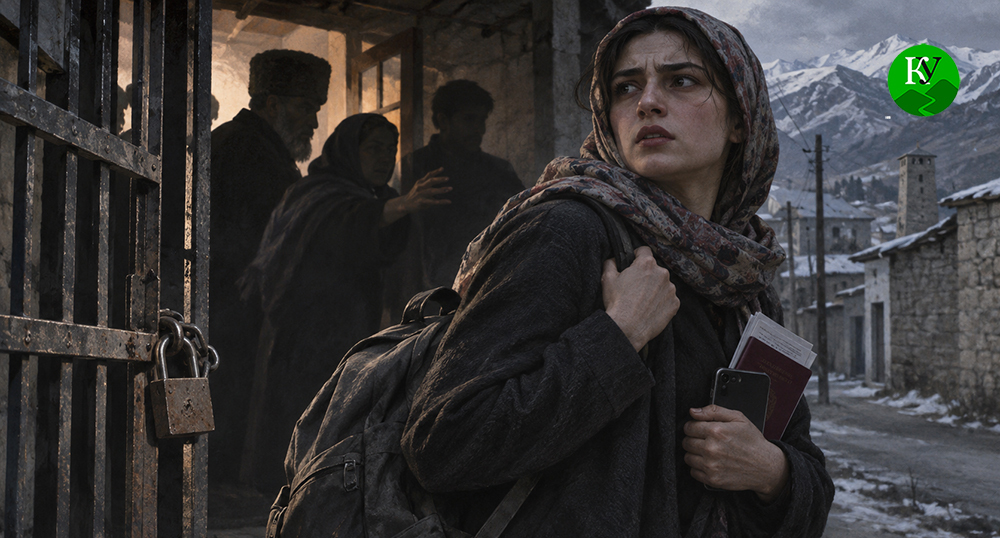
Victims of domestic violence from the North Caucasus republics who were forced to flee and disclose their case, upon returning to their families, most often face deprivation of all rights, restrictions on freedom, forced marriage, and even murder. The main mistake of the runaways is often their attempts to reconnect with former acquaintances, human rights defenders noted.
As reported by "Caucasian Knot", on November 5, it became known about the story of a girl of Chechen descent who fled from relatives in the Volgograd region after years of violence and threats of forced marriage. The girl, under the pseudonym Samira, said that her family intended to take her back to Chechnya, and after her escape, relatives tried to find her and intimidated those who helped her. According to Samira, police officers helped her protect herself from her relatives.
Human rights defenders lack resources to save girls from domestic violence
Even if we see that the situation is serious, sometimes we simply lack the resources to evacuate the girl.
Samira's story is not an isolated case, and forced marriage remains one of the common reasons for girls seeking help with evacuation, noted human rights defender Svetlana Anokhina.
"This is a serious problem, and often girls see no other way out but to flee. I specifically counted, among the requests for evacuation – 18 appeals related to being forcibly married or being about to be forcibly married. This fear begins to haunt girls quite early. The youngest girl who contacted us said that in her village, girls are married off very early and she fears such a fate for herself. I corresponded with her for a long time. It is clear that we cannot help her in any way, except for advising her to study. It would be good to have an argument to convince her parents to postpone the wedding and to seek allies among relatives," Anokhina told a correspondent from "Caucasian Knot".
According to the human rights defender, girls often fear seeking support among relatives, as they perceive the entire extended family as one side of the conflict.
"They feel that the whole tuhums (family community), the entire clan, the whole extended family is united with the parents. Recently, there was an appeal when a girl said that when she refused to marry, and she did not shout but calmly told her relatives, her father, who had always been very loyal to her and treated her with care, for the first time in her life, as she wrote, hit her. That is, we have many girls who live in fear that their normal human life will end tomorrow, and they will simply be faced with the fact that they will now be the wife of an unknown man," Anokhina said.
Human rights organizations cannot evacuate all those who seek help, as significant financial resources are required for the evacuation of girls and ensuring their further living conditions, Anokhina noted.
"We cannot evacuate everyone who asks for help, and this is terrible. Even if we see that the situation is serious, sometimes we simply lack the resources to evacuate the girl, where to take her, and we also need to support her. This requires money. Therefore, we have now appealed to our subscribers for donations because we are catastrophically short of funds," she explained.
After evacuation, human rights defenders require girls to adhere to safety measures, primarily to refrain from contacting relatives and their previous acquaintances. However, emotional attachment to loved ones often leads runaways to violate these rules, creating a risk of their whereabouts being discovered, Anokhina noted.
"They require girls to refrain from communications with relatives, friends, and all those to whom their heart is attached. But girls often break down and want to know how their mother is, how their sister is, how their grandfather is, and this is how they get caught," the human rights defender noted.
It is impossible to guarantee the long-term safety of a girl even after her evacuation beyond Russia, Anokhina pointed out. According to her, much depends on the caution of the runaway herself, random circumstances, and adherence to the recommendations of human rights defenders.
"Even if a girl is taken somewhere in Europe. Much depends on a multitude of circumstances and on the caution of the girl herself, and on random encounters. But absolutely everyone is advised to keep a low profile, not to stand out, not to use social networks openly under their own name. These are basic things that we explain at the very first stages," Anokhina summarized.
Activist warned of the threat of retribution against the victim after returning to the family
After the girl returns to the family, she may be killed, and everything will be done to avoid punishment for this.
Many circumstances of Samira's story are typical for girls trying to escape from domestic violence, noted activist Elena Patyaeva. In her opinion, early escape often becomes the only way to gain independence, as after marriage and childbirth, leaving the family becomes significantly more difficult.
"Undoubtedly. I would say that many details of her story are very typical, almost universal: both the fact that she was taken out of school and controlled every step, and that she realized that escape was the only way out long before reaching adulthood. And this is true – in a huge number of such stories, escape is the only chance for a free life. Moreover, it is precisely early escape. After marriage, it is much harder to flee, and after having children – almost impossible," she told a correspondent from "Caucasian Knot".
The main problem in organizing evacuations, Patyaeva identified the lack of state support for human rights organizations. According to her, help for girls is provided by structures whose work is under pressure from the state.
"They are forced to carry out their activities underground, not only receiving no help from the state but often facing active opposition from state agents on the ground," Patyaeva added.
The activist pointed out that relatives often use personal connections and the assistance of representatives of state structures to search for runaway girls. The help that police officers provided to Samira, she called an exception to the common practice.
"It's great that in this particular story, there were conscientious police officers, but how many stories will there be where, on the contrary, police helped relatives search for the runaway?" Patyaeva said.
The consequences of a girl's return to the family depend on the behavior of relatives and can include violence, restrictions on freedom, forced marriage, and even murder, the activist noted. According to her, in some families, runaways may be sent for so-called re-education to strict relatives or closed institutions.
"In fact, it varies greatly, it depends heavily on the specific family. In some families, the girl will be quietly killed, doing everything to avoid punishment for this crime. In some families, the girl will be beaten with greater or lesser intensity, deprived of all rights, and her every step will be completely controlled, but at the same time, they will 'forgive' her, 'give her a second chance' – that is, they will not kill her. Some families will consider it necessary to send the girl for 're-education' or to a special institution (illegal semi-underground clinics that 'treat' drug addiction, homosexuality, depression, disobedience, etc. – but actually subject young people and minors of both sexes to torture and inhumane treatment) or to some strict relatives. Some will hasten to forcibly marry the girl off to almost the first passerby. There are many scenarios, not all are capable of killing their own daughter, but all other options do not promise anything good," Patyaeva said.
One of the most common mistakes girls make after fleeing, Patyaeva also identified attempts to restore communication with friends or relatives. According to her, even trusting contacts can lead to the disclosure of the runaway's whereabouts and the resumption of persecution.
"Not all friends can be trusted, but often this is realized when it is already too late, and relatives, even the most beloved ones, in such stories are even more untrustworthy. This is a very understandable human error, but it costs many their freedom, and some even their lives. Naturally, all cases are individual, but the general rule is that if you do connect with someone from your past life, it should only be when you are already safe and only through such communication channels that cannot be tracked. And it is better not to do even that, because any connection gives relatives a lead and only fuels their activity," the activist explained.
Human rights defenders help girls at the evacuation stage, but cannot ensure their safety throughout their lives, Patyaeva emphasized. According to her, even when leaving for abroad, long-term protection remains a problem.
"Naturally, human rights defenders prepare girls for this, inform them about the risks, tell them about the rules they will need to follow in the future, most likely for the rest of their lives. And then it depends on the girl herself where she will draw the line between freedom and safety," Patyaeva said.
Some runaways get used to the restrictions and continue a full life while following safety recommendations, but others are not ready to give up publicity and communication, the activist noted. As an example, she cited the story of Aishat Baymuradova, who died after fleeing from Chechnya.
The human rights defender linked the girls' escapes to pressure and threats from parents
Some parents perceive their child not as a person but as property and stop hearing them.
The stories of girls forced to flee their families due to violence and threats of forced marriage continue to repeat, noted the president of the Center for the Study of Global Issues of Modernity and Regional Problems "Caucasus. World. Development" Saida Sirazhudina. In her opinion, the cause of such conflicts is the attitude of parents towards children as property rather than as independent individuals.
"We often hear about situations where girls are forced to flee. And we will continue to hear. Because forced marriages, trauma, psychological pressure, and, worse, threats of 'honor killings' are not something everyone can endure. Parents perceive children not as individuals. But as property. They stop hearing them," she told a correspondent from "Caucasian Knot".
Preventing escape could be achieved through dialogue between parents and children, but in situations of immediate threat to life, evacuation becomes a forced measure, Sirazhudina believes. She emphasized that human rights defenders try to resort to such a method of protection only as a last resort.
"You just need to listen to your child. Find a solution. Samira could not withstand the pressure. It was her choice, more than evacuation. It should be understood that evacuation is an emergency measure. A measure when you need to save a life. Many human rights defenders avoid it until the last moment. Because it is a difficult path. It is an independent life," the human rights defender explained.
After fleeing, the danger for the girl may not only persist but also intensify, and the psychological consequences of the violence experienced in childhood continue to affect her life, Sirazhudina noted.
"The threat to the girl's life becomes sharper after the escape. This threat persists. Always," she emphasized.
According to the human rights defender, one of the reasons for violating safety rules is the emotional dependence on loved ones, with whom girls find it difficult to completely cease communication.
"Because it is difficult to give up contact with loved ones. To sever all ties," Sirazhudina noted.
Translated automatically via OpenAI from https://www.kavkaz-uzel.eu/articles/428165