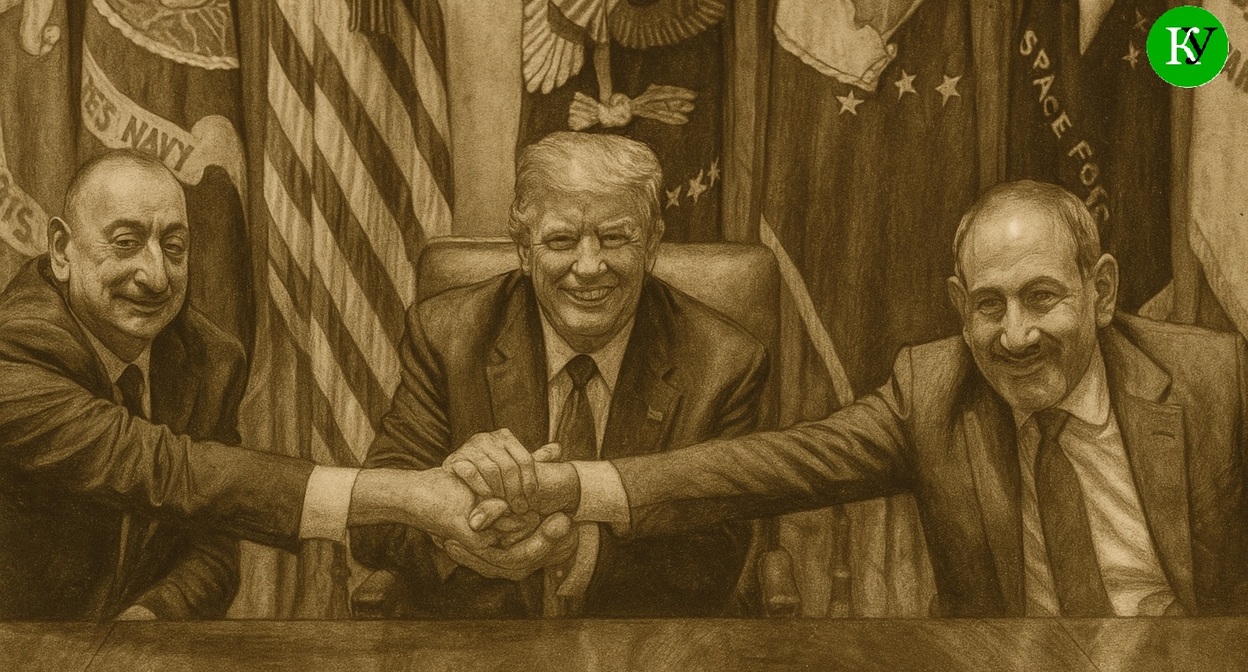


Azerbaijani analysts questioned the exchange of exclaves with Armenia.
The idea of exchanging enclaves and exclaves between Baku and Yerevan sparked heated debates among Armenian and Azerbaijani social media users: both sides took categorical positions against the surrender of land. Azerbaijani analysts, however, allowed for a coordinated exchange considering legal grounds and security interests, but disagreed on the strategic value of the territories and the possibility of transferring Armenia's exclaves.
As reported by "Caucasian Knot", on October 16, representatives of the Armenian authorities stated that no agreements on the exchange of enclaves and exclaves with Azerbaijan had been reached. The decision on the exchange should be put to a nationwide vote.
On October 4, Armenian Prime Minister Nikol Pashinyan proposed to resolve the issue of enclaves and exclaves on the border with Azerbaijan by exchanging territories of equal area. According to him, after the delimitation of the border, there should be no enclaves left on either side, and all communications should be unblocked. Pashinyan referred to his preliminary impression from talks with Azerbaijani President Ilham Aliyev in Turkmenistan. The proposal by Nikol Pashinyan to exchange territories with Azerbaijan was received ambiguously by political scientists from Armenia interviewed by the "Caucasian Knot", who pointed to legal complexities and security risks. Azerbaijani analysts considered the idea rational, but objected to keeping Artsvashen with Armenia.
Commentators debated the territorial claims of Baku and Yerevan
Aliyev can have claims to the historical lands of Armenia, while we are obliged to change the Constitution
Statements about the ownership of territories and the possibility of returning residents sparked a discussion on the "Caucasian Knot" Facebook page*, which has about 164.6 thousand users. Two posts on this topic collectively garnered 171 user reactions and 789 comments.
Users speaking from the Azerbaijani side justified territorial claims with historical arguments. "During the Soviet era, we remained silent about the transfer of our lands. Now we can speak about it loudly," wrote Dilara Kuliyeva.
"Yes, all the territories of present-day Armenia are indeed the ancestral Azerbaijani lands. There’s no need to look far: just open military maps of the Russian Empire from the last two and a half centuries and you will see it with your own eyes: toponyms, names of cities and settlements – everything is Azerbaijani," stated Eyub Abasov.
"What do you mean which ones? What is called Armenia on the map is entirely the Yerevan Khanate, a historical Azerbaijani land!" believes Ramiz Huseynov.
Participants in the discussion speaking from the Armenian side rejected these claims and pointed to their one-sidedness. "There are no Azerbaijani territories there. Aliyev is overstepping. He should remember the history of Nakhchivan, Bakurakert, Artsakh, and then talk about the lands of Azerbaijan, if they even exist," stated Armen Vladimirovich.
"So it’s absurd: Aliyev can have claims to the historical lands of Armenia, while we are obliged to change the Constitution so as not to have claims to them," countered Varuzhan Ispiryan.
"Who is Aliyev before the profound history, the intertwining of empires, wars, losses, and conquests that scholars, institutions, archaeologists, laboratories reveal, and there’s no end to it? Who is he?" questioned Luba Ovsepian.
Azerbaijani analysts pointed to the legal and strategic conditions for the exchange of territories
All of Azerbaijan's exclaves are located in strategically important territories and are significant objects. No one will give them to Armenia
The exchange of enclaves and exclaves will require a nationwide vote in Armenia, noted Azerbaijani parliament member Rasim Musabekov. He allowed for the combination of this issue with the adoption of a new Constitution and the choice between European and Eurasian integration directions. In his assessment, conducting three separate referendums would be difficult for Nikol Pashinyan's government.
"He needs to combine all these issues into one knot and then conduct the vote," explained Musabekov, whose words were cited by Vesti.az on October 20. The deputy also urged not to push the Armenian Prime Minister into hasty decisions: it is necessary first to calculate the content and timing of the vote.
At the same time, the very admissibility of the exchange does not imply agreement on which territories may become its subject. First, the parties must mutually transfer exclaves and only then determine further steps, stated the head of the political scientists' club "South Caucasus" Ilgar Velizade.
He suggested discussing the exchange of surrounding areas to connect the exclaves with the main territory of the respective country and ensure continuous transport communication. The transfer of Azerbaijan's exclaves to Armenia was rejected by Velizade. "All of Azerbaijan's exclaves are located in strategically important territories and are significant objects. No one will give them to Armenia," stated Velizade, whose words were cited by Pressklub.az on October 20.
The possibility of a coordinated exchange was positively assessed by political scientist Elman Telmanoglu. However, he distinguished between the exchange of territories and the delimitation and demarcation of the border: the exchange, in his assessment, requires separate consent from the parties.
Telmanoglu warned that presenting territorial solutions as one-sided concessions could complicate negotiations. "Therefore, decisions should be made taking into account historical maps, legal documents, and security interests," emphasized Telmanoglu, whose words were cited by Bizimyol.info.
He also pointed to the need for legal guarantees and mechanisms for the practical implementation of agreements.
Equality of areas alone does not ensure the equivalence of the exchange, pointed out political scientist Turana Rzaeva. He compared the mountainous Artsvashen, which he called Bashkend, located far from the border, with Kyarki, through which the M-2 highway connecting the north and south of Armenia passes. He also considered the strategic significance of Upper Askipara, Barkhudarli, and Sofulu to be substantial.
Rzaeva noted that predominantly Pashinyan's proposals are publicly known, while Azerbaijan's official approach to the fate of enclaves and exclaves remains unclear. "For us, the priority issue is undoubtedly the final peace agreement," noted Rzaeva, whose words were cited by Mia.az.
In the analyst's assessment, Baku may return to the territorial issue after signing a peace treaty, which Rzaeva linked to changes in Armenia's Constitution.
Translated automatically via OpenAI from https://www.kavkaz-uzel.eu/articles/427659