

Grain Crisis in Southern Russia
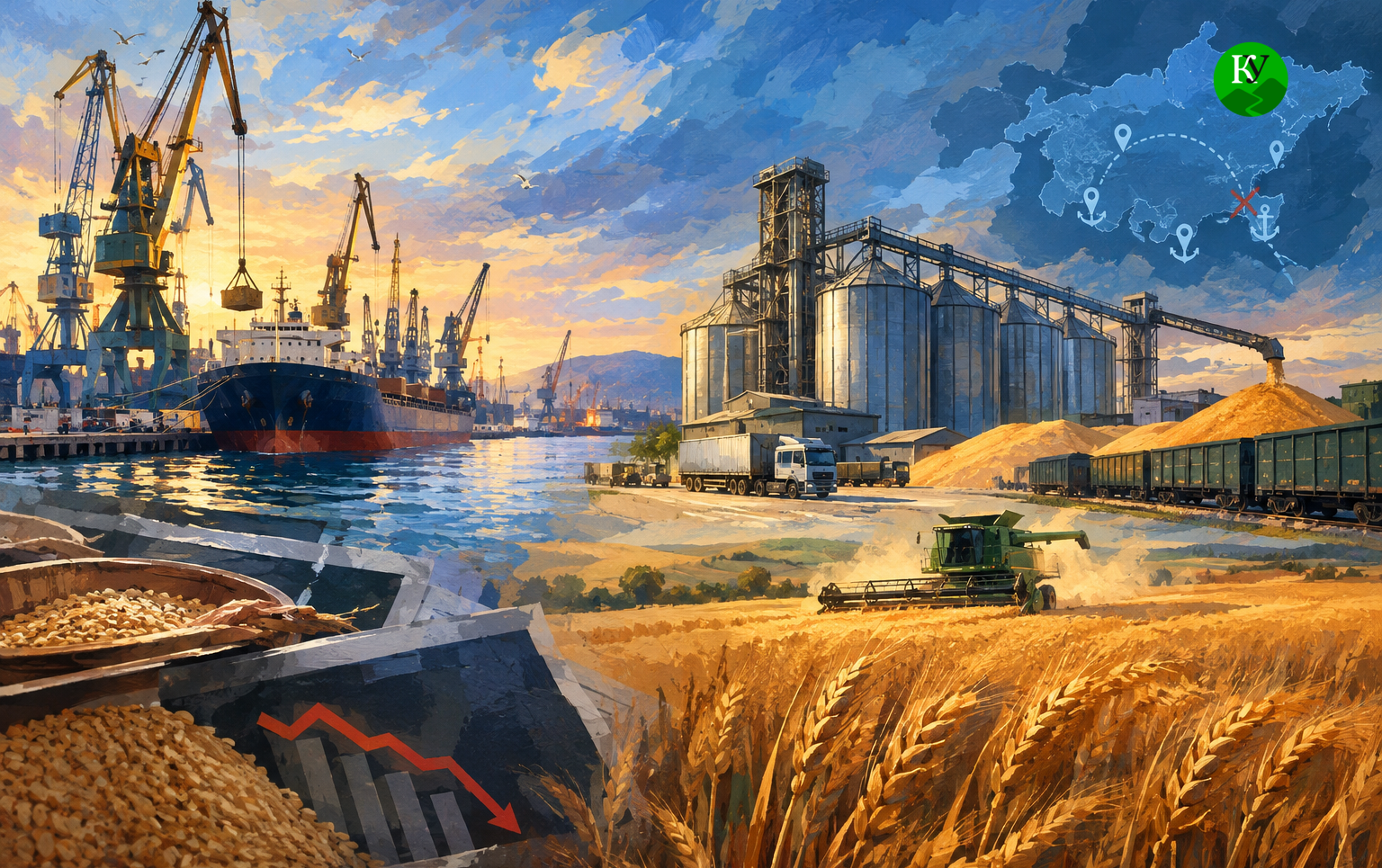
At the end of August – beginning of September 2026, the operation of large grain terminals in the Azov-Black Sea basin came to a halt after a series of drone strikes on the ports. Disruptions in transportation quickly hit agricultural regions: farmers faced the threat of mass financial failures and forced reductions in sowing.
By the beginning of September 2026, Russian agrarians in the south of the country faced a sharp reduction in opportunities for grain exports. After the ports in southern Russia, through which 80% to 90% of all Russian export grain passed, were put out of action, producers began to accumulate significant volumes of harvest, and they were forced to sell their harvest at prices half below the cost price. The most difficult situation is in the Rostov region, Krasnodar, and Stavropol territories.
What Caused the Crisis
The first serious disruption occurred after a drone attack on Novorossiysk on the night of August 12, 2026. Port infrastructure facilities were damaged, including grain transshipment capacities 1.
The Novorossiysk grain terminal (NZT), part of "Demetra-Holding", and the grain terminal of the Novorossiysk grain processing plant (NKHP) suspended operations. Their capacities are 8.5 million and 7.1 million tons per year, respectively 2.
According to "Caucasian Knot", as a result of the attack in Novorossiysk, more than 90 residential buildings were damaged, six private houses and at least one apartment were completely destroyed. Three people died, and 24 were injured. City facilities were also damaged, a bridge collapsed, and there were disruptions in electricity and water supply.
On August 13, 2026, the third major grain terminal in Novorossiysk – KSK, owned by the "Delo" group of companies, suspended operations. The company explained the decision by the need to ensure the safety of workers and infrastructure 3.
From August 13 to 19, "Russian Railways" imposed restrictions on the transportation of goods, including grain, to the port of Novorossiysk. By the end of August, the restrictions imposed by the Ministry of Transport of the Russian Federation on the movement of vessels along the Azov-Don Canal completed the isolation of the region. The operation of terminals in Taman, Azov, Yeysk, and Rostov-on-Don was blocked. As of early September, actual grain shipments were carried out under strict restrictions only through a few ports and small Caspian points 4.
On August 28, 2026, a regional state of emergency was declared in the Rostov region. In the order of Governor Yuri Slyusary, published on the regional legal information portal, it is stated that due to the increasing attacks by the Armed Forces of Ukraine on logistics facilities, navigation in the Azov-Black Sea basin has been disrupted. This led to the accumulation of "significant volumes" of agricultural products with producers 5.
"Priceless" Grain
In July, grain prices sharply fell, noted the director of the Grain Union of agricultural producers in the Rostov region, Anatoly Kolchik. "I heard offers for 6 rubles per kilogram – depending on the area and logistics, the price varies from 6 to 12 thousand per ton. As a result, for most farms, the price turns out to be below the cost price," he stated.
Farmer Sergey Kolesnikov from the Stavropol region described the situation in the warehouses as follows: "Everyone has grain in the warehouses. We laugh that the grain is 'priceless'. That is, there is no price. Grain is now an unsellable product. It cannot be sold" 6.
Alexey Zhdanov, chairman of the council of the Association of Peasant (Farm) Enterprises of the Rostov region, also reported a lack of buyers and a halt in shipments. "There is simply no shipment, no buyer, the ports are not working. Neither Novorossiysk accepts, nor Azov, nor Rostov. The price has dropped to a ridiculous level – 8000 for a ton of wheat with VAT. This is a pittance, below the cost price" 7.
At the same time, farmers reported an increase in costs for fuel and transportation of the harvest amid falling wheat prices. According to "Caucasian Knot", the price of diesel fuel in Stavropol increased by 10 rubles over the month.
Expert Assessments and Statistical Indicators
Problems with sales became noticeable back in mid-August. A paradoxical situation arose – the closure of ports provoked a rise in world prices 8, but southern agrarians are suffering losses, receiving about 8000 rubles per ton at a higher cost price 9.
The reduction in port capacities led to a reassessment of export forecasts. Vladimir Petrichenko (analytical center "ProZerno") noted a decline in shipment potential and emphasized the lack of buyers in the south. "For our agrarians, this is not just bad, but very bad," he stated 10.
The head of "SovEcon" Andrey Sizov pointed to the need for further reductions in forecasts. After the closure of the Azov direction, according to him, 1–2 million tons of grain were falling out of exports monthly. Due to the shutdown of Novorossiysk, an additional 2–3.5 million tons were added to this volume. Later, Sizov named the Baltic region as one of the main resources for redirecting exports. At the same time, he noted that they are not able to fully replace the Black and Azov Seas 11.
According to official data from the Russian Grain Union (RZS), in August 2026, grain shipments from the Russian Federation collapsed by 3.8 times, and the number of countries importing Russian wheat decreased from 43 to 16 12.
According to the analytical center "SovEcon", the increase in logistics costs amid the blockades of the Azov Sea and the ports of the Krasnodar region amounted to 40–50 dollars per ton, and ship insurance – 4–7 dollars per ton 13. The information-analytical platform Tridge, citing data from marine insurers and brokers, also recorded a sharp jump in insurance rates in the Black Sea after the August attacks to 0.5%–1% of the value 14.
The president of the Russian Grain Union Arkady Zlochevsky warned of the risk of bankruptcies among producers. According to him, wheat prices were falling by 100–200 rubles a day and in many regions had already fallen significantly below the cost price. If the situation persists, the sowing for 2027 may be at risk, he stated 15.
The director of "Shchelkovo Agrochem" Salis Karakotov linked sales problems to the deterioration of the solvency of farms, which "owe very large sums". He also pointed to rising costs due to the need to change traditional supply routes. "What we used to bring through Novorossiysk port, we now have to transport around, through Europe, to St. Petersburg. This extends the route several times" 16.
What Authorities and Agencies Proposed
The Russian government allocated 9.7 billion rubles for subsidizing railway tariffs 17. However, the expansion of land transportation is limited by a shortage of grain transport wagons and an increase in transport distance.
At the end of August, exporters began to actively consider the Baltic direction. According to Reuters, by August 18, applications for the transportation of grain by rail to Russian Baltic ports reached 5 million tons, while Russian Baltic ports have a total capacity of about 7 million tons per year. They cannot fully replace southern directions 18. However, according to the president of the Grain Union Arkady Zlochevsky, attempts by the authorities to redirect grain flows to the Baltic ("Vysotsky Port") faced infrastructure limitations, the shallowing of the Volga, and congestion on the railway. "900 thousand tons a year will not save the Motherland" 19.
On September 2, 2026, the subcommittee of the Ministry of Economic Development decided to eliminate export duties on Russian wheat, barley, and corn until December 31. Duties on sunflower oil and meal were fixed at the August level – 7748 and 312 rubles per ton, respectively. The Ministry of Agriculture created an operational headquarters to redirect agricultural exports 20.
Among the proposed measures to overcome the grain crisis, the authorities also intend to implement additional measures – a moratorium on the bankruptcy of agricultural enterprises, maintaining their preferential status as agricultural producers amid declining sales 21.
Notes
- Two grain terminals in Novorossiysk were damaged due to drone attacks // Vedomosti, 12.08.2026.
- The largest grain terminals were attacked in Novorossiysk // Agroinvestor, 12.08.2026.
- The "Delo" group announced the suspension of the grain terminal in Novorossiysk // Forbes.ru, 13.08.2026.
- Grain storages are not being exported // Kommersant, 26.08.2026.
- A state of emergency was declared in the Rostov region due to disruptions in port operations and navigation // TASS, 28.08.2026.
- Neither Russian nor Ukrainian grain is being exported this year // BFM.ru, 12.08.2026.
- A state of emergency was declared in the Rostov region due to problems with agricultural product exports // BFM.ru, 28.08.2026.
- Wheat prices on the Chicago exchange rose to $7.79 // TASS, 28.08.2026.
- Grain is not counted // Kommersant, 31.08.2026.
- The Novorossiysk grain terminal KSK suspends grain transshipment due to UAV attacks // BFM.ru, 14.07.2026.
- Wheat shipments from the Russian Federation decreased by 3.8 times amid the logistics crisis // TSK.ru, 01.09.2026.
- There, too.
- SovEcon lowered the forecast for grain exports from Russia // sovecon.ru/blog/sovecon/2026/07/30
- https://insights.tridge.com/speaker-product-news-reports/KJLyFXpzJzgKuB1Gqsm5QUKHGgR43AVdqLZX5FTjaja43WDJToYx9W1V
- The decline in domestic wheat prices accelerated // Agroinvestor, 25.08.2026.
- Neither Russian nor Ukrainian grain is being exported this year // BFM.ru, 12.08.2026.
- More than 9.7 billion rubles allocated for subsidizing agricultural product transportation // rzd-partner.ru, 31.08.2026.
- Russian grain exports shift to Baltic as Black Sea trade disrupted // Reuters.com, 31.08.2026.
- The head of the grain union on the troubles of Russian peasants and grain exports through the Baltic // Fontanka.ru, 01.09.2026.
- Russia will eliminate export duties on grain until the end of the year // Kommersant, 02.09.2026.
- The agricultural sector is rushing to help // Kommersant, 06.09.2026.
Translated automatically via OpenAI from https://www.kavkaz-uzel.eu/articles/426440




![Tumso Abdurakhmanov. Screenshot from video posted by Abu-Saddam Shishani [LIVE] http://www.youtube.com/watch?v=mIR3s7AB0Uw](/system/uploads/article_image/image/0001/18460/main_image_Tumso.jpg "Tumso Abdurakhmanov. Screenshot from video posted by Abu-Saddam Shishani [LIVE] http://www.youtube.com/watch?v=mIR3s7AB0Uw")