


Drivers spoke about the difficult fuel situation in Dagestan.
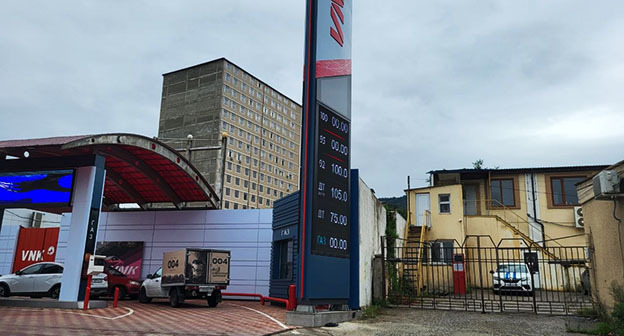
For Dagestani motorists, amid the fuel crisis, monthly gasoline expenses have increased by several thousand rubles, forcing them to cut back on trips, drivers reported. Creating a competitive environment would solve the problem in the fuel market of Dagestan, but for now, prices are being restrained by pressure from law enforcement and authorities, analysts noted.
As reported by "Caucasian Knot", on August 11, residents of Dagestan stated that a meeting held on August 9 between the head of the republic's Ministry of Internal Affairs and gas station owners did not lead to a reduction in gasoline prices.
In Makhachkala, only two out of ten gas stations were operational
A correspondent for "Caucasian Knot" surveyed ten gas stations located on Akushinsky Avenue in Makhachkala on August 17. Of these, only two were operational. Akushinsky Avenue is the longest street in the city, leading towards the Northern bus station and connecting the center with the exit to the federal highway "Caucasus".
At one of the two operational gas stations, there was no AI-95 gasoline available. At this station, AI-92 is sold at a price of 100 rubles per liter. At the second operational station, AI-95 is sold for 105 rubles per liter, and AI-92 for 100 rubles per liter, reported the correspondent for "Caucasian Knot".
Expenses have increased by several thousand rubles
Since June, expenses on gasoline have increased by several thousand rubles per month, said a car owner from Makhachkala Ramazan.
"I cannot reduce my trips, as I am engaged in transporting tourists. The competition is high, and I had to lower my service prices to a minimum. People are outraged that in other regions, the cost of fuel is much lower than in Dagestan, and the authorities can do nothing about it," he explained to the correspondent for "Caucasian Knot".
A driver from Makhachkala Rashid expressed his opinion on the high fuel prices in Dagestan. "Gasoline expenses are very high; I only drive when necessary. I believe that the high cost of fuel is due to those who do not allow network gas stations into Dagestan. Then, under competitive conditions, prices would decrease," he told the correspondent for "Caucasian Knot".
A local driver Abduragim noted that the slight decrease in fuel prices in Makhachkala did not solve the expense problem. "Recently, gasoline prices have decreased by 5-10 rubles, but this does not solve the problem; expenses are still high. Mine have increased by 3-4 thousand rubles a month. I switched to gas; here, expenses are a bit lower," he told the correspondent for "Caucasian Knot".
Fuel prices have also slightly decreased in Kaspiysk, a local driver Murat reported to the correspondent for "Caucasian Knot". According to him, at one of the gas stations, AI-95 is sold for 100 rubles per liter, and AI-92 for 95 rubles.
At the end of July, AI-95 gasoline was purchased from intermediaries at an average price of 100-110 rubles per liter, and at the beginning of August, its price decreased to 90-95 rubles, said a staff member of one of the gas stations in Makhachkala. "Currently, there are total inspections of gas stations; no one can impose a large margin," he explained to the correspondent for "Caucasian Knot", without naming the exact difference between wholesale and retail gasoline prices.
An economist linked high fuel prices in Dagestan to the lack of competition
The market for fuel and lubricants (GSM) in Dagestan is divided among independent fuel sellers, noted economist Khalil Khalilov. "Regional independent players have densely populated the territory of the republic with their gas stations; they are confident that federal networks will not be able to push them out of the market and will not create the usual competitive pricing environment found in all regions," he told the correspondent for "Caucasian Knot".
The high markup on fuel may be due to entrepreneurs acting solely in their corporate interests, Khalilov believes.
The decrease in gasoline prices has been achieved through pressure from law enforcement and the government
"The GSM market has traditionally been high-margin, and no one in Dagestan is ready to switch to lower profitability, including on a psychological level. A normal markup should be 15-20 percent. In Dagestan, there is no competition, but rather a dictatorship of private gas stations. In neighboring regions, there is some competition, there are franchises of federal networks, and this saves the situation there. The solution to the problem in the republic could be the creation of a competitive environment with the participation of vertically integrated fuel and energy companies. As for the observed decrease in gasoline prices, it has been achieved not through market mechanisms, but through pressure from law enforcement and the government. This further characterizes the absence of market regulation of supply and demand," Khalilov believes.
The inventory of gas stations as a pilot project, together with specialists and representatives of the city administration, was conducted only in Makhachkala and has not yet been completed, said the head of the Union of Entrepreneurs of Dagestan Magomed Abakarov. He noted that gas stations with the fewest violations were surveyed first.
Speculators with large sums of money sell fuel to whomever they want and whenever they want
Of the 104 officially registered gas stations in Makhachkala, 83 were closed, Abakarov reported to the correspondent for "Caucasian Knot".
Experts have recorded the beginning of a second wave of the fuel crisis, which could be particularly painful for Dagestan, as the republic has no oil refining capacities and is completely dependent on external supplies, noted the head of the Union of Entrepreneurs of Dagestan.
"Where entrepreneurs previously purchased fuel, it is practically absent, and if it is available, it is sold only for cash. They cannot purchase gasoline directly from refineries. In this sphere, there is a kind of 'major league' – business with large funds. They buy fuel in large volumes, ship it to their bases, and sell it from there, to whomever they want and whenever they want. They can afford to wait 30 days or more, keeping a certain stock," Abakarov explained.
Claims that gas station owners in Dagestan set a margin of 40-50 rubles are not true, Abakarov stated. According to him, AI-95 gasoline delivered to Makhachkala by mid-August cost 90-100 rubles per liter.
"The margin can be a maximum of 30-40 rubles; situations vary. An entrepreneur can set it at a level they deem necessary. No one mentions that they must declare fuel by law, pay taxes, and incur other expenses," explained the head of the Union of Entrepreneurs of Dagestan.
Dagestan is the southernmost region of the country, so delivering fuel to the republic is more expensive, noted earlier the head of the Federal Antimonopoly Service (FAS Russia) for Dagestan Kair Babaev.
"In the republic, large network gas stations have not yet appeared, where there is a clear pricing system. Today, private individuals operate in the fuel market in Dagestan, and we, as an antimonopoly body, cannot influence them because there is no large player occupying at least 8 percent of the market," the agency's Telegram channel quoted him as saying.
Translated automatically via OpenAI from https://www.kavkaz-uzel.eu/articles/425842




![Tumso Abdurakhmanov. Screenshot from video posted by Abu-Saddam Shishani [LIVE] http://www.youtube.com/watch?v=mIR3s7AB0Uw](/system/uploads/article_image/image/0001/18460/main_image_Tumso.jpg "Tumso Abdurakhmanov. Screenshot from video posted by Abu-Saddam Shishani [LIVE] http://www.youtube.com/watch?v=mIR3s7AB0Uw")