


Baku analysts pointed to Azerbaijan's right to decide the fate of the "We and Our Mountains" monument.
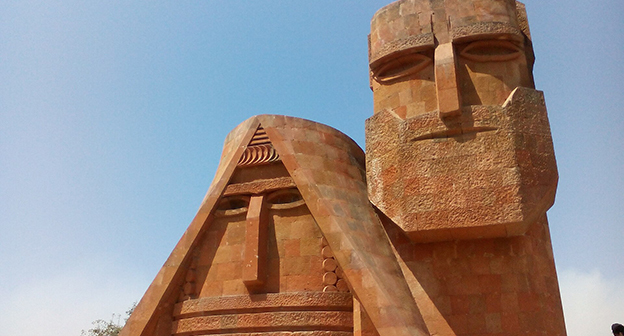
The "We Are Our Mountains" monument was erected in Karabakh when it was part of the Azerbaijani SSR and has no cultural or historical value, Baku analysts have pointed out, emphasizing Azerbaijan's right to decide the monument's fate. They believe the dissemination of fake news about the monument's demolition was organized to benefit the Armenian opposition.
As reported by the "Caucasian Knot," on June 22, the office of the cultural heritage ombudsman and the Nagorno-Karabakh Culture and Tourism Development Agency stated that reports of Azerbaijanis demolishing the "We Are Our Mountains" monument in Stepanakert have not been confirmed. The image showing the demolition process was generated using artificial intelligence. Official Baku and the Armenian opposition have extracted political benefits from an unsubstantiated report about the demolition of a monument in Stepanakert, according to Armenian political scientists.
Baku analysts pointed to Azerbaijan's right to decide the monument's fate.
"The 'We Are Our Mountains' monument in Karabakh was erected in 1967 and was not initially associated with any historical events or political symbolism. It was an example of Soviet-era monumental art dedicated to ordinary people and workers. The image of an elderly man and woman symbolized the residents of Karabakh, which in the USSR was known as a region with a high life expectancy. "At the same time, the monument conveyed a collective image of the region's residents without any emphasis on ethnicity. Already during the collapse of the USSR, the monument began to be used as a symbol of Armenian separatism in the region," Shahin Hajiyev, editor of Turan's analytical service, told a "Caucasian Knot" correspondent.
Responding to a question about the possibility of demolishing the "We Are Our Mountains" monument, Hajiyev noted that it is located on Azerbaijani territory and was built using funds from the budget of the Azerbaijan SSR, of which the modern Republic of Azerbaijan is the legal successor. Therefore, according to him, the Azerbaijani state has the right to independently decide its future.
This is an internal matter for Azerbaijan, especially since the monument is not a World Heritage Site.
"From the perspective of the historical memory of the people of Azerbaijan, this object has no significant political or artistic content. If the monument continues to be used as a symbol of separatism and revanchism in Armenia and beyond, then a decision may ultimately be made to dismantle it. This is an internal matter for Azerbaijan, especially since the monument is not a World Heritage Site," Hajiyev continued.
Commenting on the suggestion that information about the monument's destruction could have benefited Azerbaijan, the analyst expressed doubt. In his opinion, as Azerbaijan and Armenia move toward a peace agreement, Baku is not interested in steps that could destabilize Armenia's domestic political situation and disrupt the negotiation process.
Furthermore, he noted that such reports of the monument's destruction could be used for propaganda purposes to discredit Azerbaijan.
"If we talk about the destruction of cultural heritage, Azerbaijan suffered significant damage as a result of the Karabakh conflict. During the years of occupation, many architectural, cultural, and religious monuments were destroyed—not only in the territory of the former Nagorno-Karabakh Autonomous Region, but also beyond its borders. The collections of local history museums were plundered, archaeological artifacts were lost and appropriated. Moreover, steps were taken to distort the history of even the Armenians themselves. Thus, in the Aghdere region (Armenian name - Mardakert, note from the "Caucasian Knot"), the "Maraga-150" monument, unveiled in 1978 to mark the 150th anniversary of the resettlement of Armenians to Karabakh after the 1828 Treaty of Turkmenchay between the Russian Empire and Persia, was destroyed. This was done to conceal the historical fact of the resettlement of Armenians to the region," Hajiyev stated.
T. Ogrul Juvarli, a member of the Azerbaijan National Public Committee for European Integration, also believes that disseminating information about the destruction of the "We Are Our Mountains" monument is unlikely to be beneficial to Azerbaijan.
What questions might Baku be asked if a decision is made to dismantle a monument perceived as a symbol of revanchism? However, for most Azerbaijanis, this monument is simply a depiction of the people, the inhabitants of this land.
In his opinion, the Azerbaijani government has no need to spread such fakes to "test international public opinion." He noted that Azerbaijan has restored its territorial integrity, and the international community generally recognizes this reality.
"What questions could Baku have if a decision is made to dismantle a monument perceived as a symbol of revanchism? Yet, for most Azerbaijanis, this monument is simply a representation of the people, the inhabitants of this land. Many visitors to the region take photos in front of the monument and share them on social media. These people have no prejudice whatsoever. However, if political tensions are artificially fueled around the monument, and its "copies" begin to appear in other countries as a symbol of militant revanchism, the monument may be dismantled," Juvarly noted.
He also added that disseminating information about the monument's destruction could be beneficial to the Armenian opposition, which seeks to accuse Nikol Pashinyan's government of inaction regarding Armenian cultural heritage.
Commentators debated the monument's fate
Discussing a post about the monument's fate on the Caucasian Knot Facebook page*, which garnered 396 comments, users primarily discussed the monument's future, its symbolic significance, and the right to make decisions about its continued existence.
Some users believe that the fate of the monument should be decided by Azerbaijani government agencies.
"On our legal land, we can build, destroy, and remake whatever we want - that's our right," said Fatima Aslanova.
"This is Azerbaijani territory, and naturally, it's under its jurisdiction to demolish or build; all of this is decided by the relevant Azerbaijani authorities," noted Elchin Axundzade.
"The demolition and destruction of any historical monument is nothing more than vandalism and barbarism!" countered Bahtiyar Ahmedov.
"They will continue to destroy as they did before," expressed the opinion of Nune Altunyan.
Discussion participants with Azerbaijani names questioned that the monument has historical or cultural value.
"What should UNESCO react to? Is this a UNESCO heritage site or a World Heritage site?" commented Samir Azaqov.
"What UNESCO? Is this an ancient historical monument? Or an ancient religious site? It has the same status as ordinary Soviet-era buildings," opined Elchin Samadov.
One user suggested moving the monument from Karabakh to another location, for example, to Russia. "We Azerbaijanis will wholeheartedly support this," wrote Elshad Aliyev.
"You have to have a heart to understand what this monument means," retorted Nona Safaryan.
"We all need peace so that our children can live long and happily. These two nations must look to the future, develop, and live on," wrote Maxabbat İsmaylova.
Translated automatically via OpenAI from https://www.kavkaz-uzel.eu/articles/424430


![Tumso Abdurakhmanov. Screenshot from video posted by Abu-Saddam Shishani [LIVE] http://www.youtube.com/watch?v=mIR3s7AB0Uw](/system/uploads/article_image/image/0001/18460/main_image_Tumso.jpg "Tumso Abdurakhmanov. Screenshot from video posted by Abu-Saddam Shishani [LIVE] http://www.youtube.com/watch?v=mIR3s7AB0Uw")