

Armenian political scientists have identified those behind the publication of a fake story about the destruction of a Karabakh symbol.
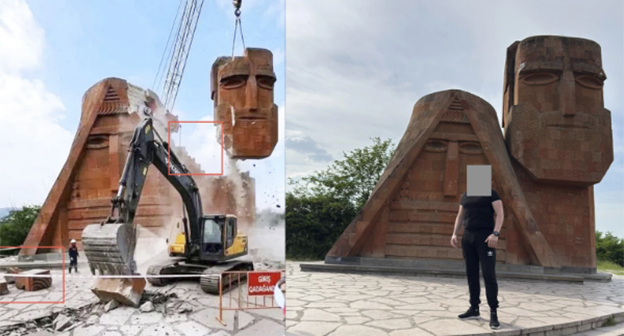
Official Baku and the Armenian opposition reaped political benefits from an unsubstantiated report about Azerbaijanis demolishing the "We Are Our Mountains" monument in Stepanakert.
As reported by the "Caucasian Knot," on June 22, the Office of the Cultural Heritage Ombudsman and the Nagorno-Karabakh Culture and Tourism Development Agency stated that the information about Azerbaijanis demolishing the "We Are Our Mountains" monument in Stepanakert was unconfirmed. The image showing the demolition was generated using artificial intelligence.
Political scientist Elena Okhikyan believes this fake news is an example of Azerbaijan's hybrid warfare. "We are witnessing a classic element of Azerbaijan's hybrid warfare. First, it's testing the waters and eliciting a global reaction. It's classic reconnaissance in force in the information space. They want to see if an international scandal will erupt, whether UNESCO, the European Parliament, and major media outlets will respond. If the reaction is sluggish, it will free them up for real action in the future," she told a "Caucasian Knot" correspondent. Second, in her opinion, this is another instance of psychological warfare. "By showing the supposed demolition of a monument, Baku is attempting to deal a psychological blow to the people of Karabakh, who have lived through the tragedy of their exodus. The goal is to instill in them the idea that everything dear to them has been destroyed, and there's nowhere to return," she noted. Political scientist Levon Shirinyan believed the fake was exploited by certain circles within Armenia. "As soon as the image reached the Armenian segment, it was immediately picked up, and these people had their own very pragmatic interests. The domestic situation in Armenia is at fever pitch. Certain opposition forces and radical activists capitalized on this news item to score political points. Under the slogan "the government can't protect anything," they artificially whipped up panic, converting a national tragedy into radicalized protest sentiment," he said.
According to him, the fake news was widely disseminated due to "irresponsibility on the part of media outlets and Telegram channels." "Fear, anger, and shock are generating millions of views. They published this fake news without the slightest verification, simply for the sake of likes and traffic. When Armenian society massively circulates lies that are then easily refuted by international fact-checkers, we fall into a trap. "When Azerbaijan actually destroys our monuments, Baku will simply tell the world that the Armenians generated everything in neural networks again," Shirinyan noted.
Discussion of the fake has sparked debates between users from Armenia and Azerbaijan
A post about a photograph circulating on social media, based on which users claim that Azerbaijani forces are using construction equipment to destroy one of the main symbols of Artsakh (the self-designation of Nagorno-Karabakh), was published on June 23 on the "Caucasian Knot" Facebook page*, which has approximately 162,000 subscribers. As of 3:00 PM Moscow time on June 24, this post had garnered 67 likes and 140 comments. Some of the authors, who identify as residents of Azerbaijan, called for the monument's removal.
"Don't worry, we'll definitely take it down," wrote Huseyn Huseynzade.
"We'll demolish it anyway. We don't need this; it has no historical value for us," said Husniyya Babayeva.
"Firstly, it's Khankendi, and secondly, it's a pity that it's fake," said Sevil Ismayilova. "We will decide for ourselves what to demolish and what to leave," wrote Ehtibar Hesenov.
The Nagorno-Karabakh Republic (Artsakh) is an unrecognized state on territory that for several decades was the scene of interethnic clashes and conflicts between Armenia and Azerbaijan. In the fall of 1991, the NKR declared its independence, and in September 2023, it declared its demise, according to a report by the "Caucasian Knot" "The Beginning and End of the Unrecognized Republic of Artsakh".
Another group of commentators opposed the monument's demolition. "It's a shame," noted Natasha Ismailova. "You don't understand anything about art." "Neither the ancient nor the modern excites or interests you," stated Ofa Arjevanidze.
A second post about a photo circulating on social media claiming that Azerbaijani forces were destroying the "We Are Our Mountains" monument was also published on June 23 on the Caucasian Knot Facebook page*. This post received 42 likes and 110 comments. Most of the authors, who also identify as residents of Azerbaijan, also spoke in favor of demolishing the monument.
"It simply must be demolished," wrote Maryam Bidari. "This monument will not be in Khankendi," stated Maya Mirişli.
"It's a matter of time. "It definitely needs to be torn down," noted Ilgar Yagubov.
"Take it and move it to your place, but we don't need anything of yours," said Shafak Kuliyeva.
Some commentators condemned calls to demolish the "We Are Our Mountains" monument. "You have nothing sacred," noted Nune Yeghiazaryan.
The "We Are Our Mountains" monument is one of the symbols of Artsakh and the entire Armenian cultural heritage of the region. The monument was built in 1967 at the entrance to the city of Stepanakert. Its authors are sculptor and People's Artist of the Armenian SSR Sarkis Baghdasaryan and architect Yuri Hakobyan, according to the website of the Armenian Museum.
We've updated our apps for Android and IOS! We welcome your feedback and development ideas both on Google Play/App Store and on KU's social media pages. You can read us on without installing a VPN. href="https://t.me/cknot">Telegram (in Dagestan, Chechnya and Ingushetia - with VPN). Through VPN, you can continue reading the "Caucasian Knot" on the website as usual, and on social networks Facebook*, Instagram*, "VKontakte", "Odnoklassniki" and X. You can watch the "Caucasian Knot" video on YouTube.
* Meta (owner of Facebook, Instagram, and WhatsApp) is banned in Russia.
Translated automatically via OpenAI from https://www.kavkaz-uzel.eu/articles/424371
![Tumso Abdurakhmanov. Screenshot from video posted by Abu-Saddam Shishani [LIVE] http://www.youtube.com/watch?v=mIR3s7AB0Uw](/system/uploads/article_image/image/0001/18460/main_image_Tumso.jpg "Tumso Abdurakhmanov. Screenshot from video posted by Abu-Saddam Shishani [LIVE] http://www.youtube.com/watch?v=mIR3s7AB0Uw")