

Pashinyan Nikol Vladimirovich
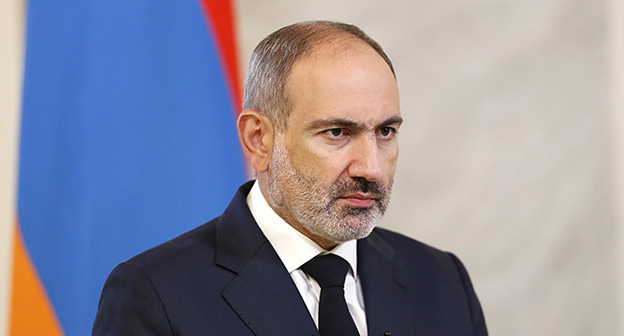
An Armenian journalist and political figure, he served as a member of the Armenian parliament since 2012. In April 2018, he led the protest movement in Armenia and succeeded in forcing Serzh Sargsyan's resignation as prime minister. He is currently the Prime Minister of Armenia.
Armenia-EU summit
A month after Nikol Pashinyan's visit to Moscow, the first Armenia-EU summit was held in Yerevan in May 2026. Following the summit, Pashinyan stated that deepening cooperation with the EU is beneficial for Armenia, regardless of its membership prospects, as it gives the country the opportunity to move toward European standards.
In the summit's final declaration, the EU reaffirmed its commitment to strengthening relations with Armenia, supporting its democratic reforms, and recognized the European aspirations of Armenian society. The European Commission described the agreements as strategic, and Ursula von der Leyen stated that new projects could transform Armenia into an important transport and energy hub for the region.
The holding of the Armenia-EU summit on the eve of the elections drew criticism: the opposition accused the prime minister of exploiting a foreign policy agenda, while some Russian media accused him of deviating from his previous course.
Meeting with Putin
On April 1, 2026, during a meeting with Armenian Prime Minister Nikol Pashinyan, Russian President Vladimir Putin stated that combining Armenia's course toward rapprochement with the EU and membership in the Eurasian Economic Union was "definitely impossible." He also stated that Moscow would "like" all pro-Russian political forces to participate in Armenia's parliamentary elections. Armenian political scientists interviewed by the "Caucasian Knot" indicated that the Kremlin is counting on Samvel Karapetyan , but he is legally ineligible to participate, as previously noted. Samvel Karapetyan's "Strong Armenia," along with Robert Kocharyan's "Armenia" bloc and Gagik Tsarukyan's "Prosperous Armenia" party, is one of the most pro-Russian parties in the Armenian parliamentary elections.
Intention to participate in the elections in June 2026
Elections for members of the ninth National Assembly of Armenia will be held in early June 2026. Nikol Pashinyan's Civil Contract Party was the first to announce its participation. According to analysts interviewed by the Caucasian Knot, the fairness of the elections is questionable, as the authorities are eliminating competitors in advance. The parties of Pashinyan, Robert Kocharyan, and Samvel Karapetyan are considered the main rivals.
On March 29, 2026, the ruling Civil Contract party officially nominated Nikol Pashinyan as a candidate for prime minister based on the results of an internal vote.
Conflict with the Armenian Apostolic Church
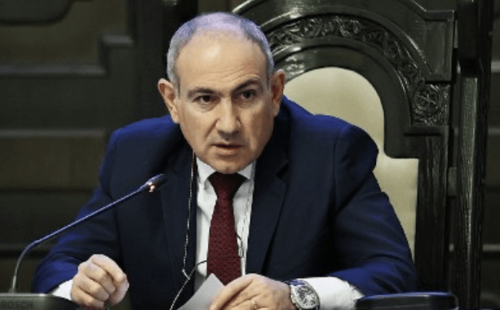 In May 2025, Nikol Pashinyan declared at a government meeting that all churches in the republic were "closet-like," explaining that all unnecessary things were being stored in churches . He also expressed surprise at "how much one can be false, talk about the sacred, be an atheist, and trample upon sacred things."
In response to criticism of his statements by a church representative, Pashinyan responded on Facebook* with insults, including those related to sexuality, and proposed giving the state a decisive vote in the election of the Catholicos. The Armenian Prime Minister's statements were condemned by church representatives and politicians. The "Ayakve" initiative called on the Prosecutor General's Office to open a criminal case against Pashinyan.
In June 2025, Pashinyan called for the election of a new head of the church, declaring that Catholicos of All Armenians Garegin II should resign because he had broken his vow.
On June 17, 2025, security forces searched the Yerevan home of Tashir Group owner Samvel Karapetyan , who supported the Armenian Apostolic Church. Forty-five people were detained near Karapetyan's home. The Church and the opposition condemned the persecution of Karapetyan. He was accused of calling for the overthrow of the constitutional order and arrested for two months. Nikol Pashinyan threatened to nationalize Electric Networks of Armenia, which belonged to Tashir Group; the company was nationalized in July . Ten of the 30 Tashir Pizza locations in Armenia were also suspended.
Visit to Turkey and opposition arrests
In June 2025, Nikol Pashinyan visited Turkey, with which Armenia has no diplomatic relations. In Istanbul, he met with representatives of the local Armenian community and stated that the visit was made possible by dialogue with Turkey. He emphasized the importance of meeting with Turkish President Recep Tayyip Erdoğan.
Simultaneously with Pashinyan's visit to Turkey, activists from the "Sacred Struggle" movement, led by Archbishop Bagrat Galstanyan, and the Armenian Revolutionary Federation (ARF) "Dashnaktsutyun" were arrested in Armenia.
Statement on preparation of a coup d'état
On June 24, 2025, Nikol Pashinyan announced that a coup d'état had been prevented in Armenia and published a copy of the opposition's "failed" plan to remove him from power on his official social media page. According to Pashinyan's post, he believes former Armenian presidents Robert Kocharyan and Serzh Sargsyan, arrested businessman Samvel Karapetyan, and the head of the Armenian Apostolic Church, Garegin II, are the direct authors of the plan. Bagrat Galstanyan was listed in the post as a candidate for prime minister during the transitional period.
From late June to December 2025, the authorities carried out a series of arrests of clergy, opposition activists, and figures associated with the Armenian Apostolic Church—from Mikael Ajapakhyan and Ruben Hakobyan to Bishop Mkrtich Proshyan, members of the Catholicos's family, and Archbishop Arshak Khachatryan. These arrests were accompanied by accusations of plotting a coup d'état, abuse of power, and obstructing election campaigning.
In January 2026, Nikol Pashinyan announced plans to "improve" the Armenian Apostolic Church, which included removing Catholicos of All Armenians Garegin II, adopting a new charter, and electing a new head of the church. On January 6, the feast of the Epiphany, he accused Garegin II of schism and sectarianism.
The political arrests that began in the summer of 2025 are described in detail in the Caucasian Knot report.
No-confidence hearings against the Prime Minister
In September 2025, the Armenian parliament held hearings organized by the opposition on the "National Crisis and Failure of Public Administration" regarding a vote of no confidence in Armenian Prime Minister Nikol Pashinyan. The initiative received 34 of the 36 signatures required to initiate the process.
Washington Declaration
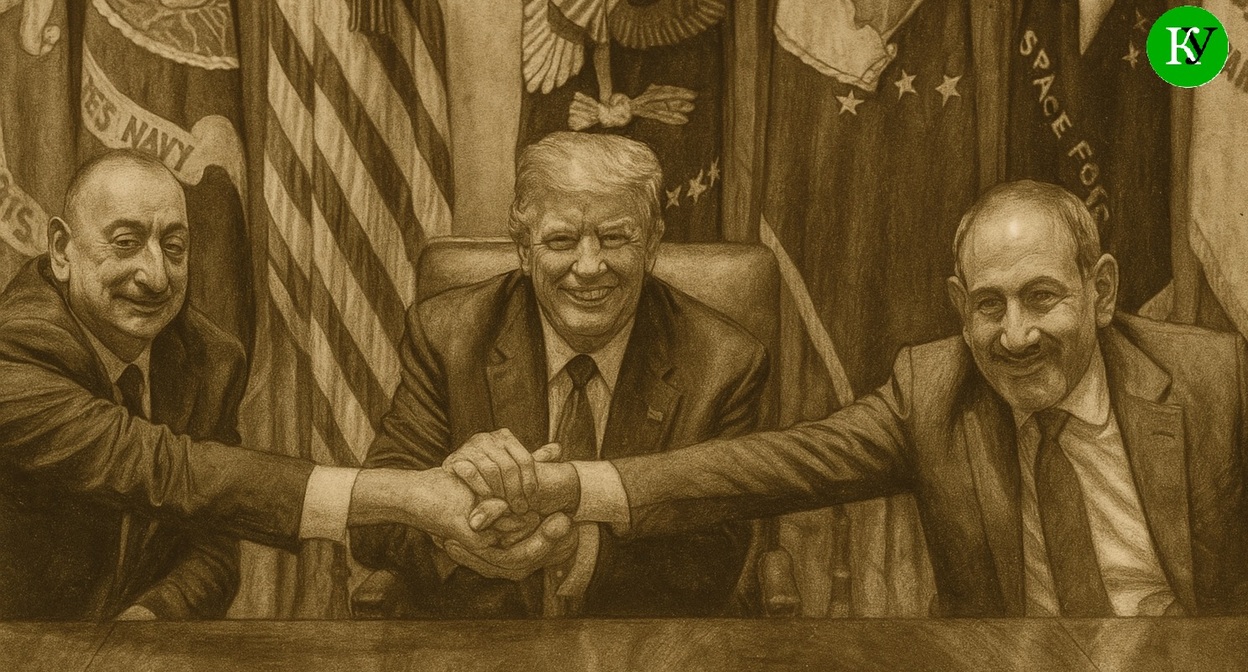
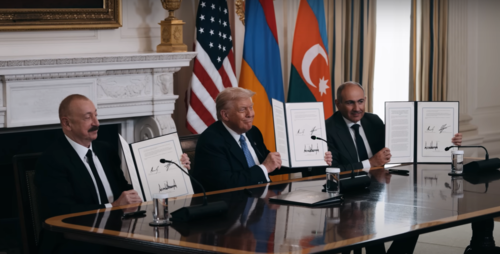 On August 8, 2025, in Washington, Pashinyan and Azerbaijani President Ilham Aliyev, with the participation of US President Donald Trump, signed a declaration on the cessation of hostilities. According to the document , Armenia and Azerbaijan commit to ending the conflict, establishing trade, tourism, and diplomatic relations, and respecting each other's sovereignty and territorial integrity. The declaration sets forth both sides' intentions to move toward a peace treaty. However, Aliyev and Pashinyan did not sign the peace agreement, merely initialing it . Analysts noted that most of the declaration's provisions contain vague language.
Trump stated that the negotiations resolved the key issue that had been preventing the signing of a peace agreement—the Zangezur Corridor. The parties intend to open a transit route connecting mainland Azerbaijan with its exclave of Nakhichevan, with the participation of an Armenian-American consortium . This project has been dubbed the "Trump Route" or TRIPP (Trump Route for International Peace and Prosperity).
In February 2026, US Vice President J.D. Vance and Nikol Pashinyan signed a joint statement on investing $9 billion in Armenia's nuclear energy sector. Vance expressed support for Pashinyan in the upcoming parliamentary elections.
On a possible war with Azerbaijan
On February 14, 2024, Nikol Pashinyan stated that Azerbaijani President Ilham Aliyev's statements during his inauguration indicated the possibility of localized clashes that could escalate into a full-scale war. Azerbaijan continues threatening rhetoric regarding Armenian military reforms and Armenia's acquisition of weapons and equipment, the Armenian Prime Minister stated.
Pashinyan noted that a number of statements made by official Baku regarding Armenia's legislative framework constitute a violation of the country's sovereignty and interference in its internal affairs.
About the new Constitution
In late January 2024, Nikol Pashinyan advocated for the adoption of a new Constitution for Armenia due to changes in the geopolitical situation. Pashinyan noted that "Armenia must have a Constitution adopted by the people through a vote. This is also an important emphasis on legitimacy." He also noted that a parliamentary system of government is the most acceptable.
Demarche against the CSTO
Following the escalation of tensions on the Armenian-Azerbaijani border and the blocking of the Lachin corridor, Pashinyan accused Russian peacekeepers of failing to fulfill their obligations and refused to hold CSTO exercises in Armenia in 2023.
Armenia's critical statements against the CSTO and the Kremlin are described in detail in a report by the "Caucasian Knot."
On November 23, 2022, the CSTO summit took place in Yerevan, following which Nikol Pashinyan refused to sign the CSTO Collective Security Council declaration and the documents "On joint measures to provide assistance to the Republic of Armenia." Pashinyan stated that the CSTO had failed to provide a clear assessment of the escalation on the Armenian-Azerbaijani border. In his view, this could mean the organization abandoning its allied obligations.
Prime Minister again
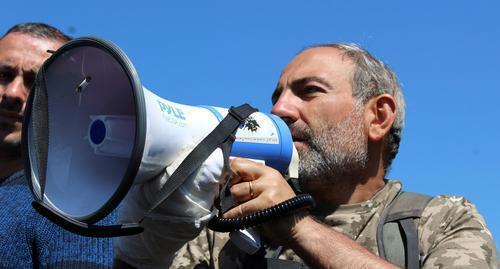 In June 2021, snap parliamentary elections were held in Armenia. Nikol Pashinyan's Civil Contract party won 53.92 percent of the vote. On August 2, 2021, Pashinyan was reappointed as Prime Minister of Armenia.
Defeat in the war
Amid unrest and protests in Yerevan following the defeat in the 2020 Karabakh War , Nikol Pashinyan resigned as prime minister along with his government on April 25, 2021. He will continue to serve as acting head of government until the snap parliamentary elections scheduled for June 20, 2021, and also reserves the right to run for reelection.
Velvet Revolution 2018
In April 2018, Nikol Pashinyan organized protests against the election of former Armenian President Serzh Sargsyan as prime minister . On April 22, Pashinyan and Sargsyan held talks, but the newly elected prime minister walked out after the opposition leader stated he was only prepared to discuss Sargsyan's resignation. That same day, during a march in central Yerevan, police detained Pashinyan.
On April 23, Serzh Sargsyan announced his resignation as prime minister, adding that he "was wrong." Nikol Pashinyan was released from the Yerevan pretrial detention center that same day .
When Acting Prime Minister Karen Karapetyan proposed holding snap parliamentary elections, Pashinyan called on his supporters to take to the streets again and boycott the potential parliamentary elections . ashinyan stated that, with the Republican Party retaining power, "the outcome of new, snap elections is entirely predictable." Karapetyan, in turn, accused Pashinyan of disrupting the negotiations.
More details about Pashinyan's rise to power and the events of the 2018 Velvet Revolution are provided in the updated photo chronicle, " How Pashinyan Rides to Power: Milestones of the Velvet Revolution ."
In late April, Nikol Pashinyan was nominated for prime minister by the Yelk faction, and the Armenian Revolutionary Federation (ARF) and the Tsarukyan bloc announced their support for his candidacy. On May 1, a vote was held in parliament, but Pashinyan's candidacy was not approved. The following day, mass protests paralyzed Armenia, and on May 8, members of parliament elected Nikol Pashinyan as prime minister on a second attempt.
By the end of September, the Yelk bloc had disintegrated, and Pashinyan had taken over the My Step bloc, which grew out of the protest movement of the same nane.
On December 9, 2018, snap parliamentary elections were held in Armenia. My Step won a landslide victory, garnering over 70% of the vote.
On January 14, pursuant to Article 149, Part 1 of the Constitution of Armenia, Armenian President Armen Sarkissian signed a decree appointing Nikol Pashinyan as Prime Minister. Pashinyan's candidacy was nominated by the My Step faction.
Criminal cases
Nikol Pashinyan has faced several criminal charges related to his journalistic activities. In July 1999, the Court of First Instance of the Center and Nork-Marash communities of Yerevan accepted for consideration the following lawsuits: defamation in an article published by the Oragir newspaper against the wife of Artashes Geghamyan, a member of the Armenian National Assembly; mention of the nickname of Norik Ayvazyan, a candidate for the National Assembly of the Republic of Armenia (RA) and professor at Yerevan State University, in an article in the same newspaper; and public insult to bailiffs (Oragir newspaper was fined $25,000 for damage to the business reputation of Mika-Armenia, and bailiffs had visited the editorial office to seize its assets). The court of first instance found Pashinyan guilty on all three counts and sentenced him to one year in prison.
The appellate court reclassified the charges of defamation and insult as official negligence, citing the publication of unverified information. Nikol Pashinyan was also charged with insulting a government official and failing to comply with a court order. He was sentenced to one year in prison (under the first article) with a one-year suspended sentence, ordered to pay 20 minimum wages in damages (under the second article), and ordered to pay the same amount in damages (under the third article). Pashinyan appealed this decision to the Court of Cassation of the Republic of Armenia, which, after hearing the case on February 2, upheld the verdict, entrusting the territorial department of the Internal Affairs Directorate with oversight of the editor. Pashinyan and his lawyers stated that the verdict was unlawful and that they would appeal it to international courts.
Political career, underground, arrest
In 2006, Nikol Pashinyan took part in the formation of the Alternative socio-political initiative, which in 2007, on the eve of the parliamentary elections, together with the Democratic Homeland Party and the Conservative Party, created the Impeachment pre-election bloc.
On May 16, 2007, following the parliamentary elections held in Armenia on May 12, Nikol Pashinyan, leader of the radical opposition Impeachment bloc and editor of the Haykakan Zhamanak newspaper, launched an indefinite sit-in protest in Yerevan's Freedom Square . Pashinyan's protest was initiated against "election fraud and the current situation in the country ." He stated that the sit-in was "proof that we will not accept the current situation and will do everything in our power to leave our children the country we dream of ." Pashinyan emphasized that he declared the strike not as a representative of a political force, but as a citizen whose rights were being violated.
In 2008, Nikol Pashinyan became a member of the campaign staff of presidential candidate Levon Ter-Petrosyan . Following mass protests against the presidential election results and the violent dispersal of peaceful opposition rallies on March 1, 2008 , which resulted in the death of 10 people and the injury of several hundred demonstrators, Pashinyan, escaping political repression, went into hiding. A wanted list was declared for him , but on July 1, 2009, after a year and four months in hiding, Nikol Pashinyan voluntarily reported to the prosecutor's office and was arrested While in the National Security Service detention center, Pashinyan began writing a series of articles, "Prison Diary," which were published in the newspaper "Haykakan Zhamanak".
On January 10, 2010, by-elections to the National Assembly of Armenia were held in Yerevan's 10th constituency, with Nikol Pashinyan running as a candidate . While in custody, Pashinyan was unable to fully campaign. Speaking at an opposition rally, Levon Ter-Petrosyan, leader of the Armenian National Congress and first President of Armenia, stated that Pashinyan's rights as a candidate had been violated from the outset, as he should have been released immediately after being registered by the constituency election.
Prison and amnesty
On January 19, 2010, Nikol Pashinyan was sentenced to seven years in prison for allegedly organizing mass riots in March 2008. On March 9, 2010, the RA Criminal Court of Appeal, applying amnesty to him, halved the unserved portion of Pashinyan's sentence .
On the night of November 10-11, 2010, an incident occurred in a common cell at the Kosh Penitentiary, where Nikol Pashinyan was being held at the time: two masked men in black attacked the journalist as he lay on bunk and began beating him . After Pashinyan began calling for help, the unknown assailants left the cell. Shortly after the incident, on November 16, 2010, Nikol Pashinyan was transferred to a punishment cell, and in late November, to the Artik Penitentiary (a closed-regime facility) . According to a press release from the Criminal Executive Department of the Ministry of Justice of the Republic of Armenia, the reason for Pashinyan's transfer to the Artik Penitentiary was "repeated violations of the prison regime" and conflicts with other inmates. Nikol Pashinyan appealed the November 16, 2010, decision of the Kosh prison administration to transfer him to a punishment cell in court.
On May 27, 2011, as part of an amnesty announced in connection with the 20th anniversary of Armenia's independence, Pashinyan was released .
Biography
Born June 1, 1975, in Ijevan, Armenian SSR. He graduated from Ijevan School No. 1 in 1991, and later that year entered the Faculty of Philology at Yerevan State University, majoring in journalism. In 1995, despite his excellent academic performance, Nikol Pashinyan was expelled from Yerevan State University for his political views.
Since 1992, Pashinyan has been actively involved in journalism; his first article was published on the front page of the Avangard newspaper.
In 1993-1994 Nikol Pashinyan worked as a correspondent for the newspaper "Dprutyun", and in 1994-1998 Pashinyan was a correspondent for the newspapers "Lragir", "Lragir or", "Molorak".
From 1995 to 1997, Nikol Pashinyan was the editor of the MSE insert of the Molorak newspaper.
From 1998 to 1999, Pashinyan served as editor-in-chief of the newspaper "Oragir." In 1999, "Oragir" was closed by the authorities, and in the summer of that year, Pashinyan became editor-in-chief of the newspaper "Haykakan Zhamanak").

![Tumso Abdurakhmanov. Screenshot from video posted by Abu-Saddam Shishani [LIVE] http://www.youtube.com/watch?v=mIR3s7AB0Uw](/system/uploads/article_image/image/0001/18460/main_image_Tumso.jpg "Tumso Abdurakhmanov. Screenshot from video posted by Abu-Saddam Shishani [LIVE] http://www.youtube.com/watch?v=mIR3s7AB0Uw")