


Tuapse authorities have attempted to limit volunteer beach cleanup efforts.
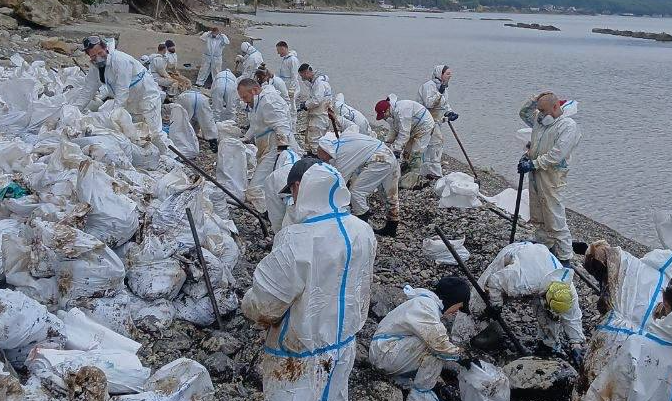
The mayor of Tuapse discouraged volunteers from participating in beach cleanups, as it was dangerous due to the equipment. Officials advised women cleaning the beaches to protect their reproductive health. Volunteers are not allowed to work on the coastline; only specialized organizations operate in the coastal area, according to representatives of the volunteer headquarters.
As reported by "Caucasian Knot," volunteers cleaning beach areas away from the city center stated that they are short of hands and lacking support from the authorities. Volunteers collecting oil from the coast of Tuapse and the surrounding area shared footage of their work on social media and reported a lack of assistance from the authorities. Liquid petroleum products are trapped under the pebbles and are more difficult to collect than the thick fuel oil in Anapa, a participant in the work noted. Volunteers are forced to clean up the aftermath of the oil spill on beaches far from the center of Tuapse on their own due to the lack of government assistance, social media users reported. The city mayor stated that the resort season will continue, and Rospotrebnadzor (the Federal Service for Surveillance on Consumer Rights Protection and Human Wellbeing) assured that water and air samples in Tuapse meet hygiene standards. Telegram users questioned this information.
A series of attacks on Tuapse's oil infrastructure has led to environmental consequences, according to the "Caucasian Knot" report "Fires and "Oil Rain": Key Information on the Ecological Disaster in Tuapse".
Volunteers in Tuapse are not allowed to work on the coastline; only specialized organizations are working in the coastal area, TASS reported, citing the "We Are Together" volunteer headquarters.
According to the headquarters, volunteers are engaged in other tasks: helping coordinate work and also participating in the cleanup of public areas in the city. The "We Are Together" headquarters told TASS this.
The head of Tuapse reported on his Telegram channel that "there are about 400 people in the volunteer reserve." "The guys from the Shepsi initiative group have been washing animals for a week now. They've asked for help with shelter and veterinarians. Together with the administration and United Russia, we're already searching for land for a potential shelter and bringing in specialists. Another group of spontaneous volunteers has reached the shore in the village of Tyumensky. Professionals and the Ministry of Emergency Situations are currently working at this site, equipped with equipment and strict safety requirements. We visited them today, and we're organizing food and removal of the collected fuel oil. Spontaneous trips to this site are not necessary; it's dangerous," said Sergei Boyko. The Tuapse administration and the regional Ministry of Emergency Situations have prohibited female volunteers from cleaning up oil spills on the shoreline, a Kommersant correspondent who was present during the conversation between officials and the volunteers reported. The ban was explained as "concerns for women's reproductive health." This demand was later reiterated at a volunteer meeting, where volunteers were asked to "understand." Some volunteers responded that they would "decide for themselves what to do with their reproductive health," the publication stated.
Kommersant previously reported that the Tuapse administration had not permitted female volunteers to clean up oil spills along the coastline, citing "concerns for women's reproductive health."
The fire caused by the drone strike was the fourth in Tuapse since April 16
The fire at the oil refinery following the drone attack in Tuapse is the fourth in the past two weeks. The previous fire occurred on April 28, when residents were evacuated from the area surrounding the oil refinery. The governor of Krasnodar Krai announced the evacuation of approximately 70 people. The smell of burning from the third fire since mid-April caused by a drone strike can be felt beyond the borders of Tuapse, according to local residents. Some fled the city, fearing the health risks of combustion products. On the morning of April 30, authorities reported that the fire at the oil refinery had been extinguished. On the night of April 20, a drone attack at the oil terminal in the port of Tuapse caused a fire that was extinguished only on April 24. During this fire, an "oil rain" fell on the city. Fires at the marine terminal are dangerous due to the release of combustion products, which are carcinogenic and toxic. "Oil rain" reduced the level of harmful substances in the air, but led to soil pollution, environmentalists emphasized. On the night of April 16, a drone attack in Tuapse killed a 14-year-old girl and an adult woman, and injured seven others. Sixty residential buildings and three public facilities were damaged, and five private homes were completely destroyed. A fire also broke out at the seaport, which was extinguished on April 19. Residents of Tuapse reported that after the attack, "the whole sky was in smoke," and the smell of burning was felt throughout the city throughout the day.
On April 24, after the booms broke through An oil spill into the Black Sea occurred due to rising water levels in the Tuapse River due to barriers. Authorities declared the spill "local," but the oil spill spread to nearby villages. Fuel oil has spread over a large area, and local residents told the Caucasian Knot on April 26, and it is being cleaned up mainly by volunteers.

As a reminder, a Tuapse resident, Evgeniya, left the city on April 28 because she believes the conditions there are dangerous for children's health.
"My apartment was destroyed after a drone attack on November 25th last year. I moved to another, quieter area, but after the latest attack, I decided to move further away. I have been renting an apartment for five months at my own expense. I do not have temporary housing. "They provided it. We appealed to the authorities for help, but they turned a deaf ear," she told a "Caucasian Knot" correspondent.
Materials about the consequences of the fuel oil spills in the Kerch Strait and in Tuapse have been collected by the "Caucasian Knot" on the page "Eco-disaster in Kuban". Data on the scale of coastal pollution was collected by the Caucasian Knot in the reference material "Fuel oil spill in the Kerch Strait".
We have updated the apps for Android and IOS! We would be grateful for criticism and ideas for development both in Google Play/App Store and on KU pages in social networks. Without installing a VPN, you can read us on Telegram (in Dagestan, Chechnya and Ingushetia - with VPN). Using a VPN, you can continue reading "Caucasian Knot" on the website as usual, and on social networks: Facebook*, Instagram*, "VKontakte", "Odnoklassniki" and X. You can watch the "Caucasian Knot" video on YouTube. Send messages to +49 157 72317856 on WhatsApp*, to the same number on Telegram, or write to @Caucasian_Knot.
* Meta (owner of Facebook, Instagram, and WhatsApp) is banned in Russia.
Translated automatically via OpenAI from https://www.kavkaz-uzel.eu/articles/422945



![Tumso Abdurakhmanov. Screenshot from video posted by Abu-Saddam Shishani [LIVE] http://www.youtube.com/watch?v=mIR3s7AB0Uw](/system/uploads/article_image/image/0001/18460/main_image_Tumso.jpg "Tumso Abdurakhmanov. Screenshot from video posted by Abu-Saddam Shishani [LIVE] http://www.youtube.com/watch?v=mIR3s7AB0Uw")