


Protesters in Tbilisi timed their march to coincide with the 105th anniversary of the battles with the Red Army.
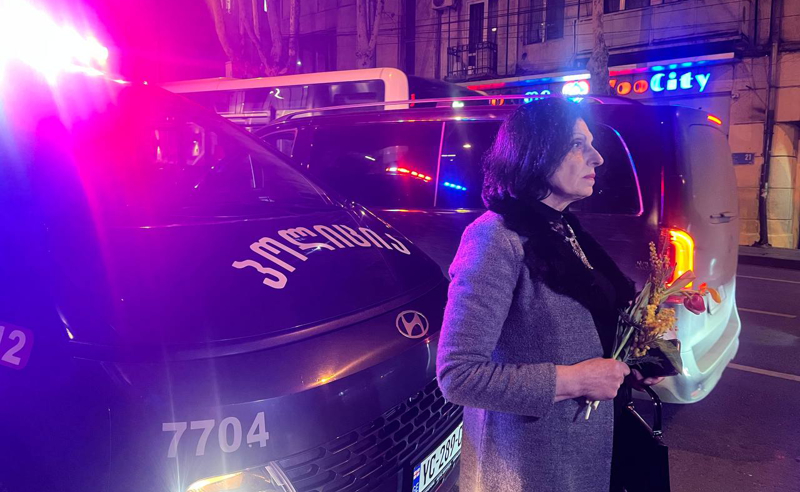
On the 455th day of continuous protests, supporters of Georgia's European integration held a march to commemorate the 105th anniversary of the Soviet occupation. Security forces prevented them from completely occupying the road, citing a lack of permission.
As reported by the "Caucasian Knot," on February 24, the 454th day of continuous protests, supporters of Georgia's European integration held a march in solidarity with Ukraine. The rally began at the Ukrainian Embassy and ended at the traditional protest site near the parliament.
The traditional evening gathering of supporters of Georgia's European integration outside the parliament building was preceded today by a march to commemorate Soviet Occupation Day. Fifth President of Georgia Salome Zurabishvili also joined the march, Pirveli TV reports.
"First of all, I would like to say that this day is not the protesters' day; it is the day of all of Georgia and all its citizens. One cannot be Georgian and not celebrate this day as a great tragedy for this country," Zurabishvili said.
The fifth president also said she did not understand the actions of the police and called on them to join the march.
"It doesn't matter who supports whom, February 25 is the day Tbilisi was seized. Anyone who is not here today supports it. What does this mean? I really don't understand, someone explain it to me. I'm ashamed of these police officers," she said. She.
Since 2010, February 25th has been celebrated in Georgia as Soviet Occupation Day. On this day, state flags are lowered, and residents pay tribute to the cadets who died in 1921 fighting the Red Army on the outskirts of Tbilisi. The invasion of Georgia by units of the 11th Red Army occurred in February 1921. Resistance by the Georgian army, volunteer units, and cadets was suppressed. On April 21, 1921, Soviet power was formed in Georgia, and the Decree on the Establishment of the People's Commissariats of the Georgian Soviet Socialist Republic was signed. For nearly three years prior, the Georgian Democratic Republic, proclaimed on May 26, 1918, had been in operation in the country.
During the march, a verbal altercation erupted between marchers and police. Police prevented a pickup truck with a loudspeaker from leading the march. Police then urged the marchers to move "in a single lane," Tbilisi_life reports.
According to the demonstrators, in accordance with the amendments to the law, they submitted a notice of the march within the prescribed timeframe. However, patrol police spokesman Goga Memanishvili stated that "they do not have permission to hold the rally or march."
Near the Georgian parliament building, the marchers lit candles and laid flowers at a memorial plaque to the heroes who died defending Tbilisi in 1921. The words "We will not accept the occupation!" were chanted.
Protesters in Georgia have been demanding new parliamentary elections and the release of political prisoners since November 28, 2024. Security forces violently dispersed the protests, using tear gas and water cannons, and detained protesters. Over 1,000 people were subjected to administrative prosecution during the protests. The "Caucasian Knot" has prepared a report, "Key Points on the Persecution of Protesters in Georgia".
Translated automatically via OpenAI from https://www.kavkaz-uzel.eu/articles/421123


![Tumso Abdurakhmanov. Screenshot from video posted by Abu-Saddam Shishani [LIVE] http://www.youtube.com/watch?v=mIR3s7AB0Uw](/system/uploads/article_image/image/0001/18460/main_image_Tumso.jpg "Tumso Abdurakhmanov. Screenshot from video posted by Abu-Saddam Shishani [LIVE] http://www.youtube.com/watch?v=mIR3s7AB0Uw")