


Residents of Cheni commemorated the victims of deportation amidst few pro-government events.
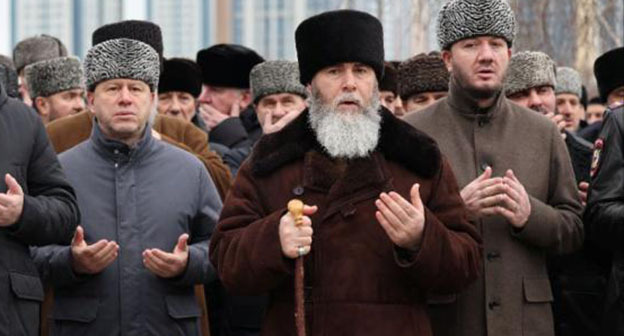
In Chechnya, an official rally in memory of the victims of deportation has been established, with the participation of officials and security forces, without the mass involvement of ordinary residents of Chechnya, who mark the mourning date in a small family circle.
As "Caucasian Knot" reported, mass events to mark the 82nd anniversary of the forced deportation of the Vainakhs to Central Asia took place today in Ingushetia, where about 500 people took part. In addition, hundreds of people gathered at the memorial complex in the Dagestani village of Novokuli (Yaryksu).
On February 3, 1944, Operation Lentil began, during which almost 500,000 Chechens and Ingush were massively deported from the territory of the Chechen-Ingush Autonomous Soviet Socialist Republic to Kazakhstan and Central Asia. More details about these events and their consequences can be found in the "Caucasian Knot" report "Deportation of Chechens and Ingush".
An event was held in Grozny where those gathered, including regional leaders and members of the public, recalled the tragic events of February 1944. "By order of the accursed Joseph Stalin, hundreds of thousands of our compatriots, including the elderly, women, and children, were torn from their homes and thrown into the cold steppes of Kazakhstan and Central Asia. "A long journey in frozen train cars, years of hardship in a harsh region, took the lives of thousands upon thousands of innocent people," Magomed Daudov was quoted as saying by Grozny-Inform.
A format for commemoration events has developed in Chechnya—a rally attended by officials and security forces, rather than mass gatherings, says political scientist Ruslan Kutayev*. "The deportation, as a tragic date, was categorically banned from being commemorated in 2013. Ramzan Kadyrov began making this claim. He said that the people themselves were to blame for being evicted, for being exiled, and that he would not allow anyone to commemorate February 23rd. We, those who were in Chechnya and engaged in human rights advocacy, appealed to Chechens in Europe and called on them to actively hold commemoration events. But they were also frightened. Then we got together ourselves, discussed everything, and decided to hold the event in Grozny. "I personally paid for a room at the National Library, and we held a conference," he told a Caucasian Knot correspondent.
In 2014, Ruslan Kutayev organized and hosted the event in violation of Chechen leader Ramzan Kadyrov's order to transfer the Day of Remembrance and Sorrow of the Peoples of the Republic to May 10. In July 2014, Kutayev was sentenced to four years in a general regime penal colony; an appeals court reduced this term by two months. He was released in December 2017. In 2023, the ECHR found that the criminal prosecution violated Kutayev's rights*.
But after some time, the Chechen authorities themselves began talking about deportation. "Kadyrov himself started talking about deportation. And I must say that our event helped Kadyrov and his authorities demonstrate that there are still Chechens who disagree with this narrative and are ready to fight for their rights, even in prison," Kutayev noted.
According to him, February 23 is also Defender of the Fatherland Day in Chechnya. "(The authorities) are holding events mainly in government buildings. This trend can only intensify because they need to maintain the rhetoric associated with the military operation. But people gather in their homes, talk about this date, discuss it, and remember it. "I don't think such a format will ever be banned," Kutayev concluded.
A human rights activist familiar with Chechen realities believes that any event related to the deportation of the Vainakhs is held with the Kremlin's permission. "Mourning events in Chechnya on this day were canceled on the Kremlin's orders. If such events are held, it is also only with the Kremlin's permission," he said.
According to him, initiatives by ordinary people to remember the victims of the deportation are suppressed by the authorities. "They can discuss it at home, but not on the street," the source noted, adding that, despite this ban, Defender of the Fatherland Day is celebrated in Chechen schools.
Adam, one of the founders of the Chechen opposition movement, pointed to a trend in the Chechen authorities' approach to the deportation date. "The mood among Chechens also influences the positions of government officials in the republic. The more zealously people defend certain principles, the more the authorities are forced to adapt to them. Therefore, (officials) hold limited-scale events. They were forced to accept that blatantly ignoring this date entails a loss of loyalty from Chechens. They try to keep this topic at a minimum, without cultivating hatred of the USSR. The regime places all the blame more on Stalin personally than on the Soviet regime," Adam said.
"People began to gather cautiously in very small groups."
In Chechnya, after the 1994-1996 military campaign, people tried to mark the day of mourning collectively, noted Ilyas, a 42-year-old construction worker. "We distributed alms, made sacrifices—slaughtered sheep, cooked meat, gathered together, and commemorated. But after the ban on mass events remained in place for several years, and the memorial day was rescheduled, people became wary of gathering in very small groups. Now, public activity is mostly limited to social media posts," he said.
"Formally, the ban seems to have been lifted. But people, having learned from bitter experience, are afraid. Mostly, things surface in messengers and social media. But of course, people remember everything; they gather in close family circles and read memorial prayers. How could they not remember? My father's cousins—all but one—died in exile as children. "He himself recalled that their greatest dream as children was to eat their fill of bread," said Abu, a 58-year-old lawyer.
Tragic Memories of Deportation Victims
For Zura, a resident of Grozny, February 23rd is the day when, as she recalls, her family mourned the innocent victims of exile in a foreign land every year. "It's like a wake: they distributed alms to the poor, remembered those who died in deportation, whose bodies rest in a foreign land. We also have a tradition of giving a 'white gift': they put refined sugar, two meters of gauze, and a packet of salt in a bag. There, in exile, this was a nice gift for every housewife. Refined sugar was usually broken into small pieces and drunk with tea. You can use gauze to strain milk and strain half-cooked cottage cheese, allowing the whey to drain. "Well, you can't cook any dish without salt," Zura explains the value of such an offering.
She says there's no refined sugar available right now, but she received a loaf of refined sugar from Turkey. She delivered her "white gift" to her neighbors the day before, so she could go with her grandson to the cemetery where her mother, Zulpa, is buried on the morning of February 23rd.
The weather began to deteriorate on the evening of February 22nd, and as the morning approached, when it was time for prayer, sleet began to fall and a strong wind rose. "I thought: the weather is the same as that February day 82 years ago. My mother was 15 that day," Zura says.
She recalls her mother's story about that distant past as if she had lived those days. "Zulpa woke up before dawn. There was no one at home: the day before, her mother, Zelimat, had loaded essential household items, rugs, books, and a large number of folders containing her husband's documents onto a cart. She had gone to Shatoy to hide everything there—rumors were circulating that the Germans might capture Grozny. Zulpa's father worked as a drilling rig supervisor. As the front approached, an order was given to shut down the wells. During this work, a fire broke out at the drilling rig, he was arrested, and a week later, he was executed. His family was unaware of this and carried parcels to the prison every day. Early in the morning of February 23, Zulpa ran to the market opening to prepare food and give it to her father. She only had time to notice the empty stalls and hear the screams and sobs of women. And there were also many soldiers. One of them grabbed her by the arm and dragged her toward a car, into which women were literally being thrown. Zulpa spoke good Russian and tried to explain to the soldier that she needed to go home—her mother would soon be back and would be worried that she was not home. "But no one listened to her anymore," Zura said.
"On the way, Zulpa fell ill, running a fever and becoming delirious. At a small station, a doctor came into the train and, with barely a glance, diagnosed typhus. She was taken to the hospital on a stretcher. Zulpa recovered quickly, but was still very weak, and the head chef of the hospital cafeteria took her under her wing. To find temporary employment for the girl in the cafeteria, she brought her a certificate of lost documents, in which her date of birth was inflated. For a while, Zulpa worked as Aunt Masha's assistant cook and negotiated permission to take leftover food to passing trains carrying people into exile. Somehow, Aunt Masha told Zulpa that her relatives were in Dzhambul and that her mother knew everything that had happened during this time. She equipped Zulpa for the journey and put her on a train heading to Dzhambul. At first, they lived in Dzhambul, until Zelimat found all her children in orphanages and even adopted a three-year-old girl who ran to her screaming, "Mom, you're my mom!"," Zura recounted.
In the first days after the deportation, people died not from disease, but from the cold, recalled deportation survivor Dagun Omayev. "Somewhere, they found either a brazier or a large cast-iron frying pan with smoldering coals. And around it, wrapped in some rags, sat people. Mostly children and women. The men started digging dugouts, which was difficult in the 30-degree frost. I sat with my mother, covered with a sheepskin coat that she had miraculously brought from home. "I was still cold and scared," an eyewitness recalled.
"I was very afraid of one Kazakh. He came into the barracks every day, walked around us—a circle of us sitting around this brazier—and then poked us with his whip. Whoever fell, he carried away. "Later I found out he was carrying away frozen children," the source recalled.
We've updated our apps for Android and IOS! We welcome criticism and development ideas both on Google Play/App Store and on KU's social media pages. You can follow us on Telegram without a VPN (with a VPN in Dagestan, Chechnya, and Ingushetia). Using a VPN, you can continue reading "Caucasian Knot" on the website as usual, and on social networks: Facebook**, Instagram**, "VKontakte", "Odnoklassniki" and X. You can watch the "Caucasian Knot" video on YouTube. Send messages to +49 157 72317856 on WhatsApp**, to the same number on Telegram, or write to @Caucasian_Knot.
* are listed as foreign agents.
** Meta (owner of Facebook, Instagram, and WhatsApp) is banned in Russia.
Translated automatically via OpenAI from https://www.kavkaz-uzel.eu/articles/421060


![Tumso Abdurakhmanov. Screenshot from video posted by Abu-Saddam Shishani [LIVE] http://www.youtube.com/watch?v=mIR3s7AB0Uw](/system/uploads/article_image/image/0001/18460/main_image_Tumso.jpg "Tumso Abdurakhmanov. Screenshot from video posted by Abu-Saddam Shishani [LIVE] http://www.youtube.com/watch?v=mIR3s7AB0Uw")