


The demand by members of the SVO to preserve a hospital in Dagestan has attracted the attention of officials
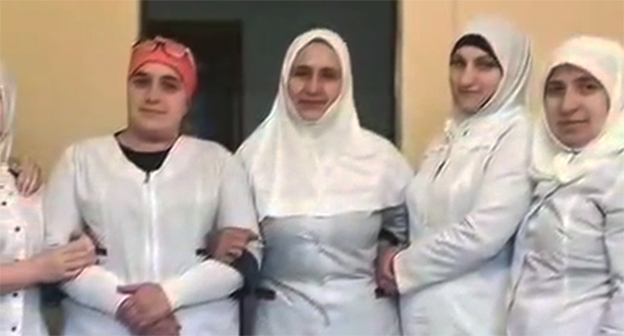
Residents of the Tsuntinsky District called on authorities not to close the district hospital, and their fellow villagers from the SVO zone also demanded that the 24-hour inpatient facility be maintained. In response, the Dagestan Ministry of Health promised to focus on the rational organization of medical care for villagers.
As reported by the "Caucasian Knot," in July 2024, participants in the military operation, in a video message to the head of the Gumbetovsky District and the Dagestan Ministry of Health, called for the district hospital in the village of Igali to not be converted into a day hospital. Residents of Igali and neighboring villages assumed that they would lose access to urgent medical care, supporting the request of their fellow villagers from the SVO zone to maintain the 24-hour inpatient facility. They explained that ambulances from the district hospital take too long to arrive.
In February 2025, residents of the village of Kikuni in the Gergebil District also asked the authorities not to close the hospital, as elderly residents regularly require medical care. The reorganization will not affect the accessibility and quality of medical care, the Ministry of Health assured, noting that, at the initiative of the Russian Ministry of Health, the process of reorganizing district hospitals is underway throughout the country, as many of them are ineffective, and some have more staff than patients.
Residents fear hospital closure
An appeal from residents of the Tsuntinsky District to Vladimir Putin, the head of Dagestan, Sergey Melikov, and the Dagestan Ministry of Health was published today on the Telegram channel of the publication "Novoe Delo." Villagers have asked that the Kitlyarata District Hospital not be closed "as part of optimization."
"The closure of the district hospital is not just 'optimization' on paper, but a blow to our history and future! This is a death sentence for elderly people who have difficulty getting to the district center. This is the fear of mothers whose children may not wait for an ambulance on difficult mountain roads," the newspaper quotes the residents' text message.
The distance from the village of Kitlyarata, where the district hospital is located, to the village of Tsunta (the administrative center of the Tsunta District), according to Yandex Maps, is approximately 18.7 kilometers by road. Yandex Maps estimates the driving time for this route at 38 minutes, taking into account sections of uneven road.
They want to reduce the district hospital to a day hospital
The hospital has been operating since 1958, the authors of the petition stated. "Why is it now under threat? Villagers have serious concerns that this decision is driven not by concern for the people, but by other interests. First, they closed the maternity hospital. We remained silent. Then they transferred the ambulance station. And that wasn't enough – now they want to reduce the district hospital to a day hospital. […] We believe that closing the hospital, located significantly far from the district center, is tantamount to leaving the residents of our villages in danger. We demand that our hospital be preserved!" – the appeal states.
According to the 2020 census data published on the Rosstat website, the population of the village of Kitlyarata is less than 300 people – 254. According to regulations, in rural settlements with a population of over 2,000 people, there must be outpatient clinics to provide primary medical care, while a district hospital is located in villages with a population of 5,000 people, lawyer Ali Aliyev previously told the "Caucasian Knot."
Fighters from the Tsuntinsky District spoke out in support of the villagers
A video titled "Military personnel sound the alarm over the hospital" was posted on February 2 on the "Caucasus Raz" YouTube channel. "A video has been released featuring service members from the Tsuntinsky District, stationed in the SVO zone. In their appeal, they raise a pressing issue: the closure of the 24-hour inpatient facility at the Kitlyaratinsky District Hospital in the mountainous region of Dagestan," the video description reads.
The video footage shows several armed soldiers. One of them delivers an appeal to Putin and Melikov on behalf of those gathered. He explains that the participants in the video are service members from the Tsuntinsky District.
They are using the guise of workflow optimization.
"We are asking you to verify the legality of this event, because they are using the guise of workflow optimization," the service members stated.
They noted that this inpatient facility is "the hope of many nearby villages." "More than 10,000 residents remain without medical care," the appeal states.
The Ministry of Health responded to the soldiers' appeal
The Minister of Health of Dagestan intervened in the reorganization of the Kitlyaratinsky District Hospital, the ministry reported today on its Telegram channel. The minister intervened "at the request of the SVO participants from the Tsuntinsky District," the publication notes.
"Residents of the Tsuntinsky District requested that the 24-hour inpatient facility at the Kitlyaratinskaya Hospital be maintained. The Minister of Health of the Republic of Dagestan, Yaroslav Glazov, instructed a detailed review of the phased provision of emergency medical care in the high-mountain terrain of the Tsuntinsky District," the ministry stated.
The ministry recalled that, in accordance with the order of the Russian Ministry of Health dated February 27, 2016, "across the country, 24-hour inpatient facilities at a number of district hospitals are being converted into day hospitals." "This has nothing to do with emergency care, which is provided in the same volumes, but the quality of planned care will improve with effective reorganization," the publication explains.
Thus, emergency medical care "for vascular accidents" is provided by the ambulance service, the Dagestan Center for Disaster Medicine, and a system of vascular departments and centers, the Ministry of Health indicated.
A district hospital, even with a 24-hour inpatient department, cannot serve as a support.
"A district hospital, even with a 24-hour inpatient department, cannot serve as a support in this structure of modern medical care. Medicine has become more organized and faster. It is the new organizational structure of the industry, developed by the federal Ministry of Health, that includes more efficient day hospitals and stronger district and inter-district associations. […] The concern of those from the district is understandable and explainable. The Ministry of Health of Dagestan will "The issue of rational organization of medical care in the highlands was thoroughly examined," officials assured.
As a reminder, SVO members from Dagestan have repeatedly recorded video messages to the republic's authorities asking them to address various social and domestic issues. Specifically, on March 5, 2025, complaints regarding inflated prices for school meals and corruption in the purchase of housing for orphans were published by fighters from the Tsuntinsky District. At the end of September, SVO participants appealed to the head of Dagestan with a complaint about the lack of sewage in Khasavyurt. Sergei Melikov promised in March 2025 that the actions of those attempting to manipulate military operation participants by sending them messages asking them to record a video message to the authorities will be harshly suppressed. Appeals from SVO participants in Dagestan to the authorities are prompted by numerous problems in the republic and remain one of the ways to gain the attention of officials. Despite Melikov's claim that combatants are recording appeals as a result of "manipulation," he will have to respond to them, analysts noted.
Authorities are keeping a close eye on appeals from the military operation zone and "reacting more quickly and attentively" to them, Magomed Magomedov, deputy editor-in-chief of Chernovik, explained to the "Caucasian Knot" in July 2024. He noted that such appeals have become a common practice. "They use such appeals to attract attention to all everyday issues that are not resolved at the local level. Sometimes, depending on the nature of the appeal, they respond quickly," Magomedov said.
Translated automatically via OpenAI from https://www.kavkaz-uzel.eu/articles/420479

![Tumso Abdurakhmanov. Screenshot from video posted by Abu-Saddam Shishani [LIVE] http://www.youtube.com/watch?v=mIR3s7AB0Uw](/system/uploads/article_image/image/0001/18460/main_image_Tumso.jpg "Tumso Abdurakhmanov. Screenshot from video posted by Abu-Saddam Shishani [LIVE] http://www.youtube.com/watch?v=mIR3s7AB0Uw")