

Three former Karabakh officials denied charges in a Baku court.
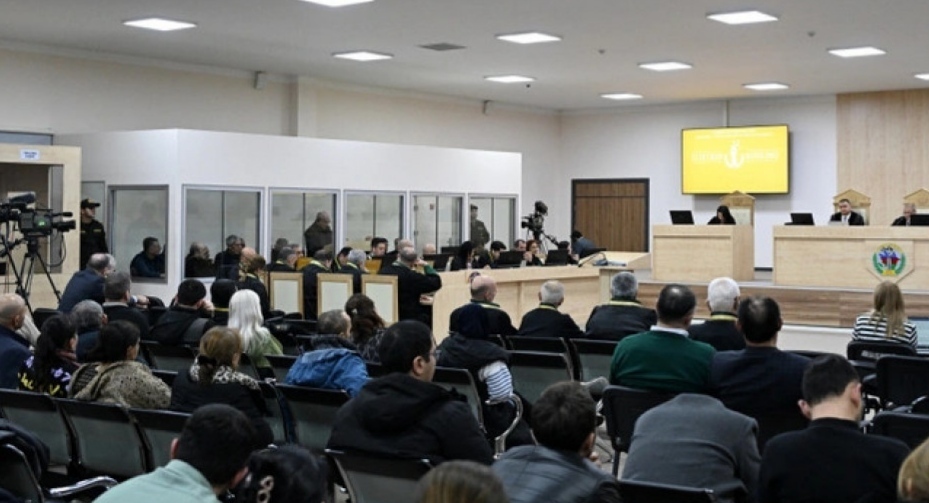
Former commander of the Nagorno-Karabakh Defense Army, Levon Mnatsakanyan, stated in the Baku Military Court that he disagrees with the charges brought against him. Two other defendants, former presidents of the unrecognized republic, Bako Sahakyan and Arkady Ghukasyan, expressed a similar position.
As reported by the "Caucasian Knot," the trial of the former leaders of Nagorno-Karabakh accused of war crimes concluded on October 31. The prosecution requested life sentences for Arayik Harutyunyan, David Ishkhanyan, David Babayan, Levon Mnatsakanyan, and David Manukyan, and 16 to 20 years in prison for the others. On December 4, the lawyers of their clients declared their guilt unproven and called on the court to acquit them. On December 11, eight defendants in the case against the military-political leadership of Nagorno-Karabakh made their final statements before the court in Baku. All of them stated that they did not consider themselves guilty of the war crimes charged against them. On December 22, Babayan and Mnatsakanyan also denied the charges in a Baku court.
The defendants are 15 former Karabakh officials, including Presidents Arayik Harutyunyan, Bako Sahakyan and Arkady Ghukasyan, as well as Parliament Speaker David Ishkhanyan. The case of Nagorno-Karabakh State Minister Ruben Vardanyan is being heard separately. They have been charged under more than 20 articles, and the case contains 2,548 counts. The "Caucasian Knot" has prepared a report titled "Vardanyan and 15 Karabakh Leaders: Key Points on the Baku Courts."
On December 25, the Baku Military Court continued hearing the defendants' final statements. Levon Mnatsakanyan continued his testimony. He stated that he disagreed with the charges brought against him and noted that he did not consider himself guilty of any of the charges, according to the publication Report.
Mnatsakanyan stated that he was retracting the testimony he gave during the preliminary investigation and asked the court to consider only what he said in the courtroom when making its decision. In conclusion, the defendant presented the court with a 51-page transcript of his three-day speeches for inclusion in the court record.
Arkady Ghukasyan also stated that he disagreed with the prosecution's evidence. He claimed that the prosecution presented his work at the Sovetsky Karabakh newspaper as a crime, a claim he disputed. He explained that he was one of the newspaper's four deputy editors, translating materials into Russian, and that he supervised 16 employees at the time. Ghukasyan said he did not consider the newspaper's activities criminal.
He added that he pleaded not guilty to all charges against him. One of his arguments, he cited, was that he left "big-time politics" in 2007 and never returned.
Defendant Bako Sahakyan, in response to the prosecution's portrayal of them as a criminal organization, said: "There was no criminal organization and there could not be."
The trial will continue on December 26.
The defendants are charged under Articles 100 (planning, preparing, unleashing or waging an aggressive war), 102 (attacking persons or institutions enjoying international protection), 103 (genocide), 105 (destruction of the population), 106 (slavery), 107 (deportation or forced displacement of the population), 109 (persecution), 110 (enforced disappearance of persons), 112 (deprivation of liberty in violation of international law), 113 (use of torture), 114 (mercenarism), 115 (violation of the laws and customs of war), 116 (violation of international law), humanitarian law during armed conflicts), 118 (war robbery), 120 (premeditated murder), 192 (illegal entrepreneurship), 214 (terrorism), 214-1 (financing of terrorism), 218 (organization of a criminal community (criminal organization), 228 (illegal acquisition, transfer, sale, storage, transportation or carrying of weapons, components for them, ammunition, explosives and explosive devices), 270-1 (acts that create a threat to aviation security), 277 (attempt on the life of a statesman or public figure), 278 (violent seizure of power or violent retention of power, violent change of the constitutional order of the state), 279 (creation of armed formations or groups not provided for by law) and other articles of the Criminal Code of the Republic of Azerbaijan, the publication says.
Translated automatically via OpenAI from https://www.kavkaz-uzel.eu/articles/419409
![Tumso Abdurakhmanov. Screenshot from video posted by Abu-Saddam Shishani [LIVE] http://www.youtube.com/watch?v=mIR3s7AB0Uw](/system/uploads/article_image/image/0001/18460/main_image_Tumso.jpg "Tumso Abdurakhmanov. Screenshot from video posted by Abu-Saddam Shishani [LIVE] http://www.youtube.com/watch?v=mIR3s7AB0Uw")