


Azerbaijani activists criticized the Amnesty Act
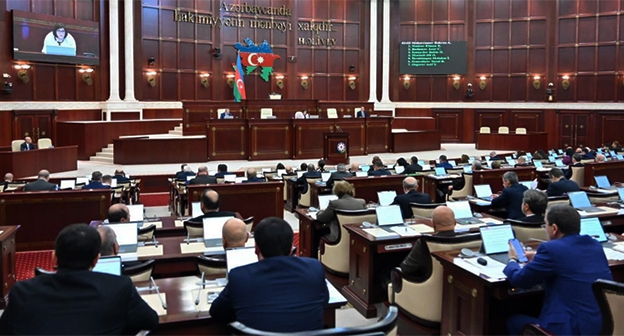
Azerbaijani activists and journalists living abroad have criticized the amnesty act adopted by the Azerbaijani parliament. They called the current amnesty a manipulation.
As reported by the "Caucasian Knot," on December 15, Azerbaijani President Ilham Aliyev submitted an amnesty act to parliament, which will affect approximately 20,000 people. The initiative is timed to coincide with the "Year of Constitution and Sovereignty" declared in Azerbaijan in 2025 and the restoration of the country's sovereignty over its entire territory, the authorities stated. Local activists welcomed the amnesty initiative, but noted that it will not resolve the problem of political prisoners.
The draft Amnesty Act will be reviewed and adopted by parliament by the end of 2025, its implementation will begin immediately and be completed within four months, a parliamentary source told the "Caucasian Knot."
17 Azerbaijani activists and journalists in exile issued a statement criticizing the Amnesty Act adopted by the National Assembly of Azerbaijan on December 19.
"The government and official media are promoting the idea that this amnesty will be the largest in terms of the number of prisoners it will affect, including those who will be released from prison. "The amnesty initiative raised public hopes for both a reduction in the prison population and the release of political prisoners. However, contrary to official propaganda, the amnesty was not an act of humanism but was used to manipulate public opinion," reads a statement received by a Caucasian Knot correspondent.
"Firstly, there are contradictions between the stated goals of the amnesty and its practical implementation. Thus, while Article 1 of the Amnesty Act states that this document has 'broad coverage in terms of its application to vulnerable social groups and areas of criminal offense,' Articles 2 and 3 stipulate exceptions that diminish the document's scope. Specifically, it states that the amnesty applies to individuals convicted of less serious crimes who have less than one year remaining in their prison sentence, and to those convicted of serious crimes who have less than six months remaining in their sentence. "Furthermore, according to Article 7 of the Amnesty Act, an extensive list of less serious crimes was added to the restrictions on the application of the amnesty, in addition to serious and especially serious crimes," the authors of the document note.
"Official claims about the unprecedented scale of the current amnesty are refuted by the very content of the document adopted by parliament," one of the signatories of the appeal, lawyer Samad Rahimli, a member of the board of the Resplatforma movement, told a "Caucasian Knot" correspondent.
According to him, claims about the "scale" of the current amnesty in Azerbaijan are refuted by historical facts. "The largest amnesties, in terms of the ratio of those released from prison to the total population, were the 1918 amnesty on the occasion of the opening of the Parliament of the Azerbaijan People's Republic and the 1992 amnesty adopted in connection with the restoration of Azerbaijan's independence," Rahimli noted.
The amnesty's release of prisoners with less than a year and less than six months remaining on their sentences "is not consistent with the philosophy of amnesty, which aims to implement acts of humanism in the context of reforms aimed at eradicating human rights violations," the lawyer believes.
"The current amnesty does not contribute to the eradication of punitive state practices and the prison overcrowding crisis to which these practices have led, nor does it solve the problem of political prisoners. "Thus, officially calling this act an amnesty is an attempt to conceal the fact that the essence of this measure is a manipulative attempt," Rahimli concluded.
One Baku lawyer also agreed with this assessment of the amnesty. "The amnesty act was drafted in such a way as to minimally affect political prisoners. Among them are many convicted under Article 234.1-1 (illegal acquisition or possession of drugs in large quantities without intent to sell), mainly believers and young activists. The amnesty provides for the release from prison only of those convicted under this article who have less than six months left on their sentences. Under the current version, only about two dozen people have been released. "At the same time, the amnesty did not apply to trade union activists Aykhan Israfilov, Elvin Mustafayev, Mohyaddin Orujov, and human rights activist Ilkhamiz Guliyev, who were convicted under this article and have less than a year left in their sentences," said a lawyer who did not wish to be named.
It should be noted that Azerbaijani Ombudsman Sabina Aliyeva described the amnesty as a step "in the context of continuing the humanization of punishment policy." "This is a continuation of the state's consistent and systematic humane policy. Amnesty acts are not only a legal mechanism but also a manifestation of social justice, mercy, and respect for human dignity," the Azertac news agency quoted Aliyeva as saying.
Translated automatically via OpenAI from https://www.kavkaz-uzel.eu/articles/419238

![Tumso Abdurakhmanov. Screenshot from video posted by Abu-Saddam Shishani [LIVE] http://www.youtube.com/watch?v=mIR3s7AB0Uw](/system/uploads/article_image/image/0001/18460/main_image_Tumso.jpg "Tumso Abdurakhmanov. Screenshot from video posted by Abu-Saddam Shishani [LIVE] http://www.youtube.com/watch?v=mIR3s7AB0Uw")