


Mutually beneficial interests have contributed to the rapprochement between Baku and Beijing
THIS MATERIAL (INFORMATION) WAS PRODUCED AND DISTRIBUTED BY THE FOREIGN AGENT MEMO LLC, OR CONCERNING THE ACTIVITIES OF THE FOREIGN AGENT MEMO LLC.
Azerbaijan and China share economic interests, particularly the development of the East-West transport corridor. Both countries also support each other on political issues, suggesting a strategic partnership between them.
On April 23, during Azerbaijani President Ilham Aliyev's state visit to China, the "Joint Statement between the Republic of Azerbaijan and the People's Republic of China on the Establishment of a Comprehensive Strategic Partnership" was signed in Beijing. The parties expressed their readiness to continually strengthen political trust, enhance mutual support, and develop comprehensive cooperation for the benefit of the peoples of both countries. They unanimously resolved to establish a comprehensive strategic partnership.
The parties also firmly support each other in choosing a development path chosen by their peoples and consistent with national conditions, and provide each other with resolute support in protecting the fundamental interests, sovereignty, security, and territorial integrity of both countries. "The Azerbaijani side recognizes that there is only one China in the world, Taiwan is an inalienable part of Chinese territory, and the government of the People's Republic of China is the sole legitimate government representing all of China. It firmly opposes any form of 'Taiwan independence' and supports the Chinese government in achieving national reunification," the statement said.
China, in turn, "resolutely supports the peace agenda proposed by the Azerbaijani side and considers confrontation-oriented geopolitical games counterproductive."
Furthermore, Baku and Beijing agreed to strengthen the alignment of the Belt and Road Initiative with Azerbaijan's national development strategy, 'Revival of the Silk Road,' and the Socioeconomic Development Strategy until 2030, in order to jointly advance modernization and create a new space for joint development with a higher level, increased resilience, and long-term stability.
A document on mutual visa-free travel was also signed.
Baku and Beijing are working on developing alternative energy
On October 3, the head of the Caspian Barrel oil research center in Azerbaijan, Ilham Shaban, a member of the Azerbaijan National Public Committee for European Integration, Togrul Juvarli, chairman of the political committee of the Republican Alternative party and co-founder of the Republic research center, Natig Jafarli, political observer Tofig Turkel, and Farida Bayramova, head of the Caucasus International Youth Travel travel agency, which specializes in organizing trips for tourists from China, commented on the prospects for developing relations between Azerbaijan and China to a "Caucasian Knot" correspondent.
Azerbaijan views China as a promising development partner Ilham Shaban believes that the country's alternative energy sector is developing.
According to him, amid forecasts of declining oil production, Azerbaijan has chosen a strategy for developing alternative energy, with the goal of eventually exporting "green energy" to Europe.
A contract already exists for the supply of one million solar power panels to Azerbaijan over three years.
Shaban noted that in recent years, construction has begun on a number of solar and wind power plants in Azerbaijan, given the country's favorable natural conditions. At the same time, he noted, China has established itself in recent years as a manufacturer of high-tech equipment, including in the field of alternative energy production. "There is already a contract to supply Azerbaijan with one million solar power panels over three years. Installation has already begun in the Bilasuvar district. The advantage of Chinese panels is that they generate energy from both sides, both from above (where the sun shines) and by reflecting heat from below," Shaban said.
Furthermore, he said, the possibility of attracting China as an investor in alternative energy production is being considered. Specifically, he continued, these issues were discussed in Baku at the end of September during a visit to Azerbaijan by a delegation from the Chinese company PowerChina Resources Ltd. Furthermore, the Chinese have partnered with Azerbaijan to establish a joint venture in Sumgait to produce electric buses.
As Shaban noted, Chinese businesses are also cooperating with Azerbaijan in the traditional energy sector. For example, China supplies high-tech equipment for the development of the Kursangi-Karabaghi oil fields.
Shaban noted that China has recently broken into the top five among Azerbaijan's importers, behind only Russia and Turkey. Overall, China ranks fourth in Azerbaijan's trade turnover.
From January to August of this year, trade between Azerbaijan and China amounted to $2.9 billion, Trend reported, citing the State Customs Committee of Azerbaijan. This is $650.2 million, or 28.4%, more than in the same period in 2024. During the reporting period, trade with China accounted for 9.16% of Azerbaijan's total trade turnover. Thus, China ranked fourth among the countries with which Azerbaijan conducted the largest number of trade transactions during the reporting period. From January to August of this year, Azerbaijan exported goods worth $60.1 million to China. This is $46.8 million, or 4.5 times, more than in the same period last year.
When asked whether China could displace Russia from Azerbaijani imports, the analyst responded that competition between the two countries is impossible due to the different types of products supplied.
Russia, Shaban noted, supplies Azerbaijan with agricultural products, food processing, metallurgy, industrial engineering, wood processing, and other products. "China is unlikely to be able to replace Russia in these sectors. However, the Chinese can increase their traditional supply of household appliances, automobiles, particularly electric vehicles, and, as I already noted, equipment for the production of alternative energy,” Shaban said.
Development of transport links is important for Baku and Beijing
Togrul Juvarli stated that the rapprochement between Azerbaijan and China began long before the cooling of relations between Baku and Moscow.
Relations between Moscow and Baku noticeably deteriorated after the crash of an Azerbaijan Airlines plane with 67 people on board in Kazakhstan on December 25, 2024, while flying from Baku to Grozny. More details can be found in the "Caucasian Knot" report "Baku-Grozny Flight Crash" and in the article "Geopolitical Confrontation: What the AZAL Plane Crash Led to." Ethnic raids in Russia and retaliatory detentions of Russians in Azerbaijan have become the latest step in the deterioration of relations between the two countries. Baku accuses Russian authorities of extrajudicial killings of Azerbaijanis, and footage of the brutal detention of Russians in Baku appears to be a demonstrative response to Moscow's actions, according to the "Caucasian Knot" report "Crisis in Azerbaijan-Russia Relations".
According to him, Azerbaijan was one of the first to actively support Chinese leader Xi Jinping's "One Belt, One Road" initiative, which envisages the development of an East-West transport corridor along a route similar to the ancient Silk Road.
The "One Belt, One Road" initiative was put forward by Chinese President Xi Jinping in September 2013. He proposed integrating land and maritime trade routes to quickly and affordably deliver goods to countries in Southeast Asia, Africa, the Middle East, and Europe. To achieve this, he proposes combining two projects: the "Silk Road Economic Belt," which includes several economic corridors, and the "21st Century Maritime Silk Road," Kommersant reports. According to Juvarly, Azerbaijan and China share similar interests in this area. He noted that Azerbaijan is seeking to maximize its transit potential to offset declining revenues from declining oil production. Juvarly emphasized that Azerbaijan's importance to China in the "One Belt, One Road" project has increased even more since the outbreak of conflict between Russia and Ukraine, which has significantly reduced freight traffic from East Asia to Europe. In addition, the advancement of China's interests was also facilitated by Azerbaijan's multilateral cooperation with Central Asian countries in developing the Middle Transport Corridor from the eastern Caspian Sea westward through Azerbaijan and the South Caucasus to Europe.
At the same time, the expert continued, Azerbaijan is rapidly developing infrastructure for transportation along the Middle Corridor, building dry cargo ships and tankers, and creating a large logistics center on the western shore of the Caspian Sea in Alyat (70 km south of Baku) with the capacity to handle 25 million tons of cargo per year.
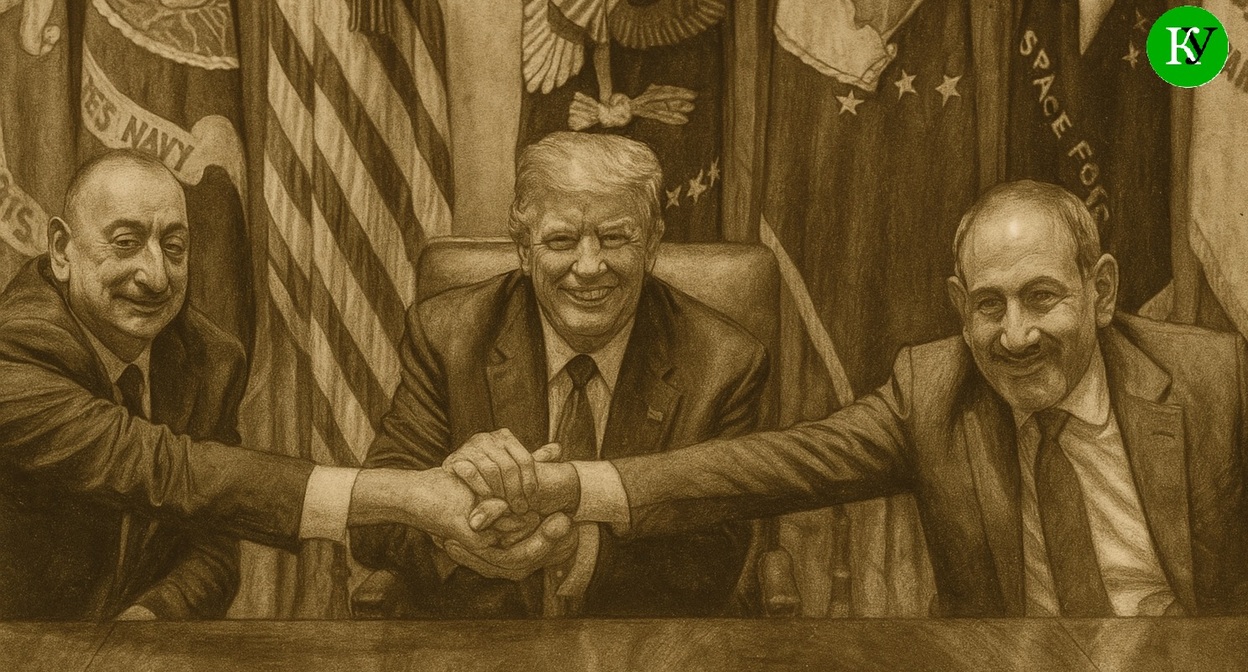
The opening of the Zangezur Corridor, or the "Trump Route," the expert further noted, could give the Middle Corridor project a qualitatively new meaning. Agreements on its implementation were reached in Washington on August 8 by the leaders of Azerbaijan, Armenia, and the United States.
US President Donald Trump stated after signing the declaration that Yerevan and Baku had managed to resolve the issue that had impeded the peace agreement, namely the Zangezur Corridor. According to him, the new transit zone will allow Azerbaijan full access to Nakhchivan, while fully respecting Armenia's sovereignty. "Armenia is also establishing an exclusive partnership with the United States to develop this corridor," Trump added, stating that significant infrastructure development by American companies should be expected in the coming years.
According to him, shippers from China and Central Asia will now have direct access through Azerbaijan to the Black Sea basin (via Georgia) or the Mediterranean Sea (via Armenia and Turkey), depending on their destination.
Relations between Azerbaijan and China are also important in a political context.
Azerbaijan occupies an important place in the broader context of China's regional policy, said Natig Jafarli.
The importance of the Middle Corridor is particularly heightened by the fighting in Ukraine and threats to navigation in the Suez Canal.
He also noted the importance of the Middle Corridor project for China. "In this context, China is actively developing relations and investing in countries located along this route. Over the past 10 years, China has invested approximately $30 billion in Kazakhstan. The Chinese are investing in transport infrastructure in Georgia. Azerbaijan is an important logistics hub for the Middle Corridor. Baku is driving multilateral cooperation in transport. Azerbaijan was the initiator of the trilateral agreement between Baku, Tbilisi, and Astana on unified transport tariffs. This was very important for the Chinese in using this route for transportation to Europe. "The importance of the Middle Corridor is particularly heightened by the military conflict in Ukraine and threats to navigation in the Suez Canal," Jafarli said.
In addition, Azerbaijan is one of the solvent states in the region and, therefore, is a promising market for Chinese goods of various types.
As for the potential of the Chinese market for Baku, according to the expert, Azerbaijan can supply agricultural products, including wine, to China. However, for now, the trade balance is heavily biased in favor of Chinese exports to Azerbaijan rather than Azerbaijani exports to China, he said.
Furthermore, Jafarli continued, mutual visa abolition was very important for Azerbaijan. "Every year, 200 million Chinese travel the world. If Azerbaijan attracts a percentage of their number, this will be a significant benefit for the country's tourism sector. The abolition of visas to China has also become convenient for Azerbaijanis. Obtaining visas was expensive in both money and time. Now, one can travel to China without a visa. This has become a great help for both Azerbaijani tourists and small businesses," Jafarli said.
Tofig Turkel also drew attention to the mutually beneficial political partnership between Baku and Beijing.
Azerbaijan and China consistently uphold the principle of international integrity of states in the international arena.
"Azerbaijan and China consistently uphold the principle of international integrity of states in the international arena. Beijing supported Baku in the Karabakh issue, which Azerbaijan had already resolved. Azerbaijan advocates the principle of one China and has no relations with Taiwan. Baku also distances itself from the international protection of the rights of Uyghur Turks, considering this issue an internal affair of China,” the analyst said.
At the same time, he pointed to the lack of military-technical cooperation between the two countries.
The number of tourists has increased after the abolition of the visa regime
The number of people traveling from China to Azerbaijan has doubled after the abolition of the visa regime, said Farida Bayramova.
The total number of tourists amounted to about 600 people
“Over the past month, our company from China had 20 "There were 20 people in each group on tours. There were also smaller groups. The total number of tourists was approximately 600. This is approximately twice as many as before, when travelers from China arrived on visas," she noted.
However, according to her, the potential for attracting tourists from China is much greater. In her opinion, high airfare prices are hindering an even greater increase in the number of tourists from China. Another problem is the closed land borders of Azerbaijan. "Chinese travelers like to visit at least two countries. They prefer to enter one and return from another. However, due to the closed borders of Azerbaijan, visiting another country becomes expensive for them. Many in the region would like to visit both Azerbaijan and Georgia in one trip. "But there is currently no land transport between these countries, and air travel is very expensive," Bayramova said.
According to her, the number of tourists from Azerbaijan to China has also increased since the visa regime was abolished. "I don't have exact statistics, but I know that the number of tourists from Azerbaijan has increased sharply in the two months since the visa regime was abolished. I studied in China and heard from a classmate and friend who works with tourists from Azerbaijan about a significant increase in arrivals from Azerbaijan. Previously, when there was a visa regime, trips were mostly made in groups. Now many are traveling to China individually," Bayramova said.
Visa-free travel to China for Azerbaijani citizens came into effect on July 16, 2025. Over the first seven months of 2025, more than 34,000 Chinese citizens visited Azerbaijan, representing a 56 percent increase, said Fuad Nagiyev, Chairman of the State Tourism Agency, at the presentation of the China Ready program held in Baku on August 27.
In 2024, the number of Chinese citizens visiting Azerbaijan increased by 93 percent compared to 2023, reaching 44,800 people, he added.
The State Tourism Agency of Azerbaijan was unable to provide comments on the statistics of tourists from Azerbaijan to China.
We have updated the applications on Android and IOS! We will be grateful for criticism, ideas for development both in Google Play/App Store, and on KU pages in social networks. Without installing a VPN, you can read us on Telegram (in Dagestan, Chechnya, and Ingushetia – with a VPN). Using a VPN, you can continue reading the Caucasian Knot on the website as usual and on social networks: Facebook*, Instagram*, VKontakte, Odnoklassniki, and X. You can watch the "Caucasian Knot" video on YouTube. Send messages to +49 157 72317856 on WhatsApp*, to the same number on Telegram, or write to @Caucasian_Knot.
* Meta (owner of Facebook, Instagram, and WhatsApp) is banned in Russia.
Translated automatically via OpenAI from https://www.kavkaz-uzel.eu/articles/415994


![Tumso Abdurakhmanov. Screenshot from video posted by Abu-Saddam Shishani [LIVE] http://www.youtube.com/watch?v=mIR3s7AB0Uw](/system/uploads/article_image/image/0001/18460/main_image_Tumso.jpg "Tumso Abdurakhmanov. Screenshot from video posted by Abu-Saddam Shishani [LIVE] http://www.youtube.com/watch?v=mIR3s7AB0Uw")